LINGER
2025
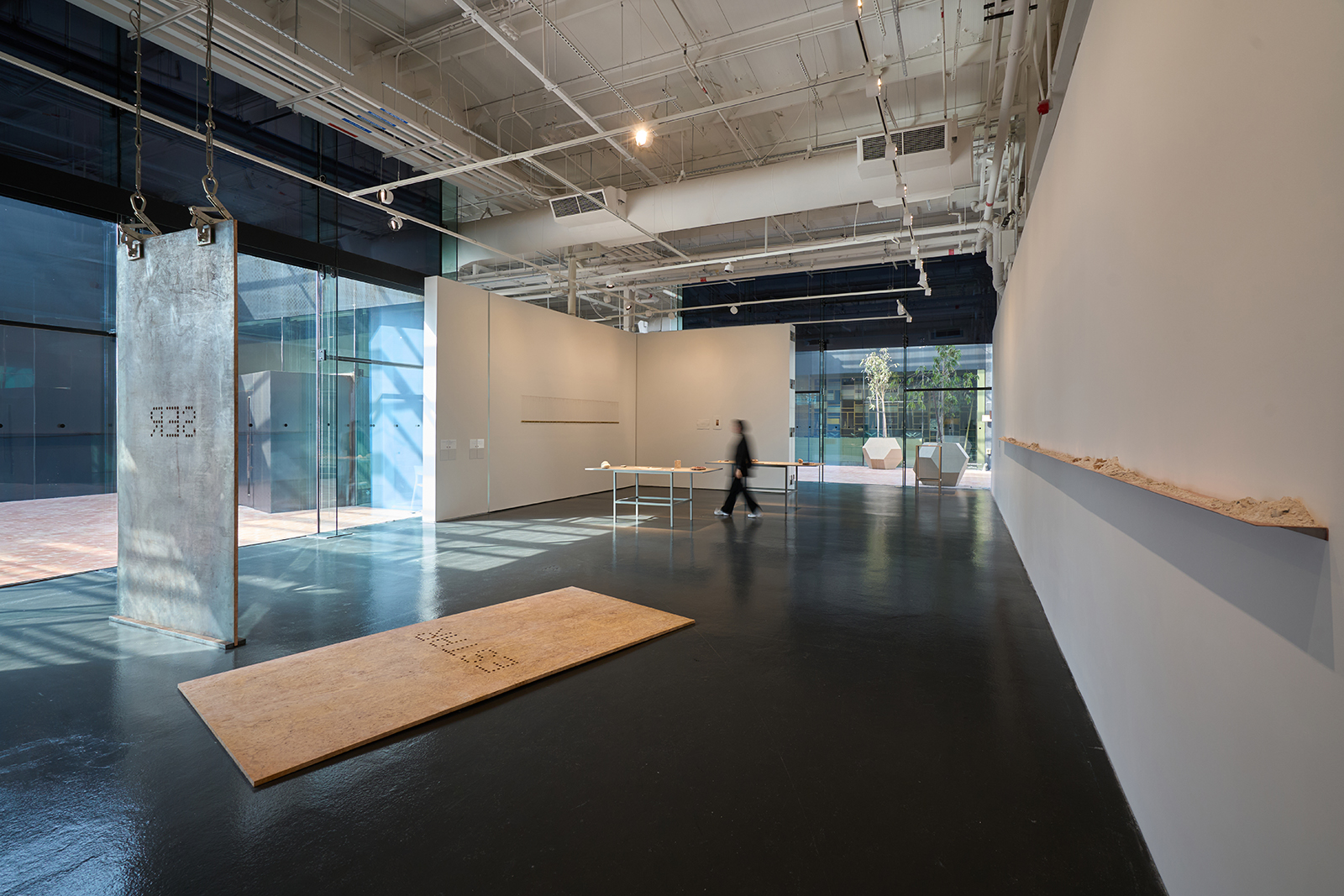
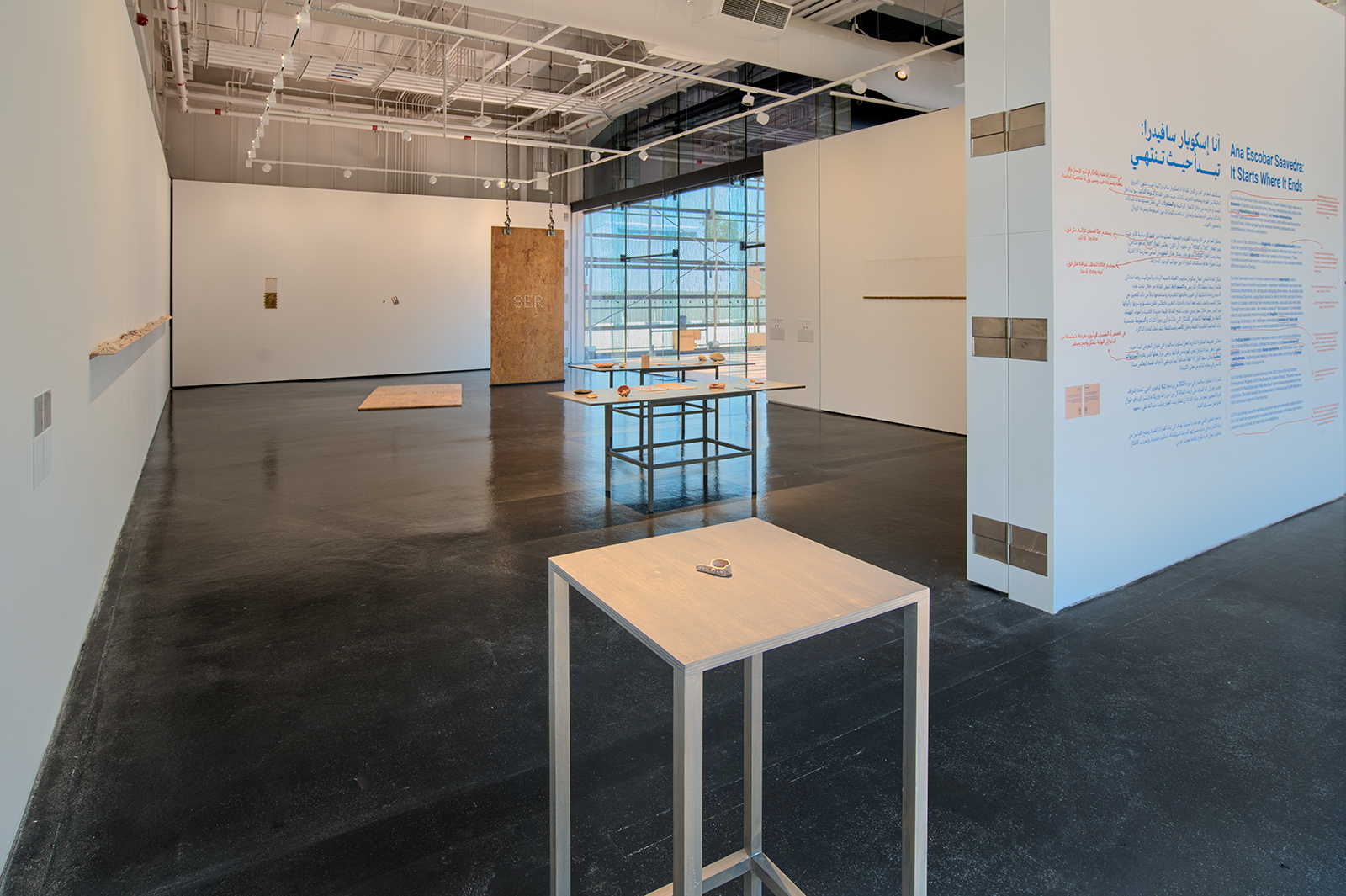
In LINGER, the artist preserves the remains of her stone-carving process collected over the course of a year. These delicate traces, such as dust particles and debris, are carefully retrieved from machine receptacles, work surfaces, and studio floors. As the water used in the process evaporates, it leaves behind sedimentary layers that the artist gently scrapes and saves. Over time, this material accumulation becomes a record of labor and transformation,temporarily placed in a shelf, forming a landscape of relics.
Escobar Saavedra’s attention to these to-be-discarded materials speaks to a conscious effort to account for every act performed upon a material, and the consequences of those actions.
SER – ESTAR
2025
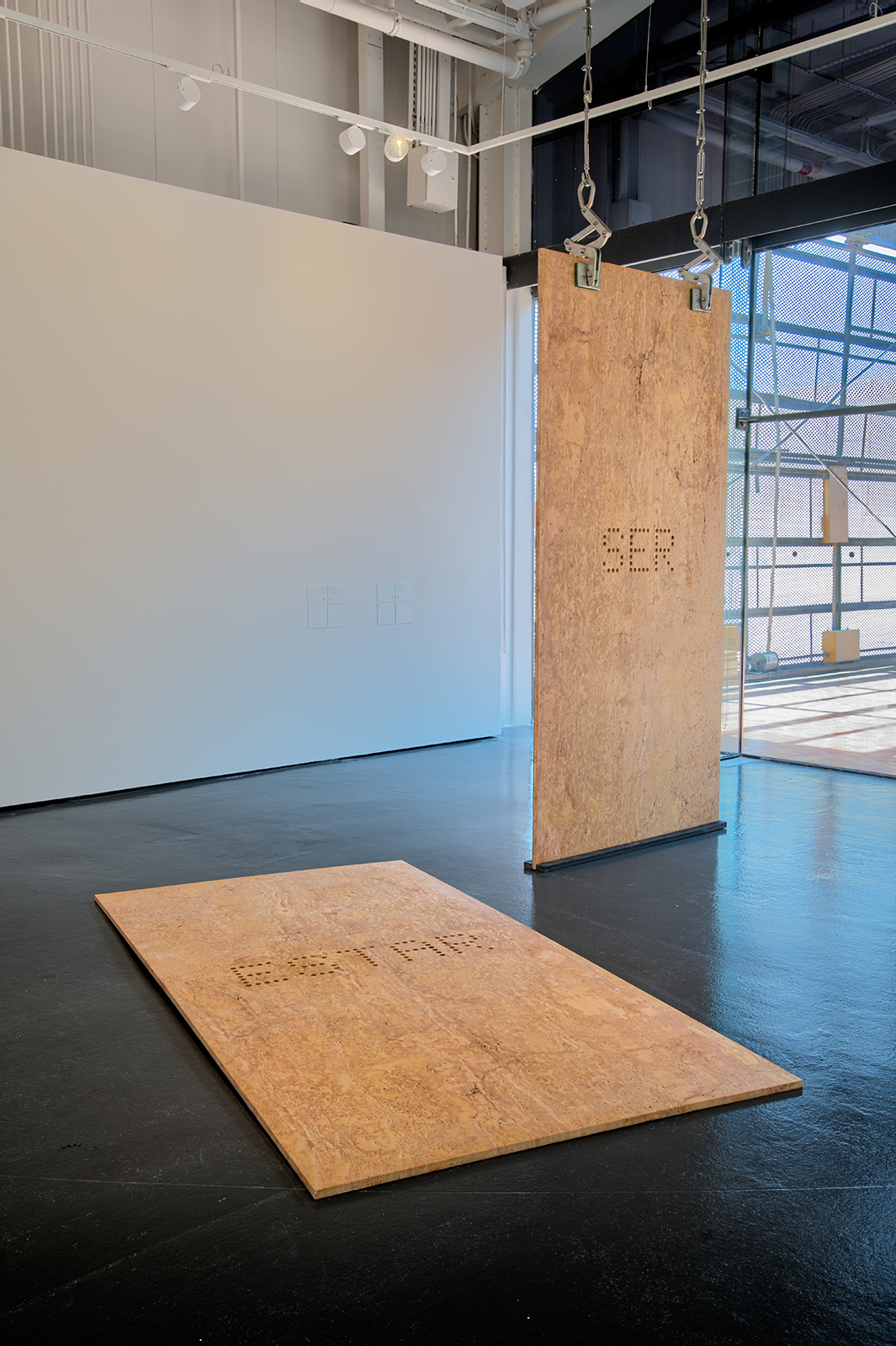
SER – ESTAR reflects on the tension between permanence and impermanence through language and material. In Spanish, ser and estar both translate to “to be,” but carry different meanings: ser, from the Latin esse, refers to what is essential or enduring; estar, from stare, relates to temporary states, conditions, or locations.
This duality is expressed through the physical act of perforation—a gesture that references both bureaucratic procedures and quarrying methods used to extract and cut stone. The words SER and ESTAR are drilled into two vertical slabs of pink travertine.
Each slab exceeds the proportions of a body but is cut to a narrow, standard construction thickness.representing at the same time monumentality and vulnerability. The stone’s tone and texture were selected in an attempt to match macro photos of the artist’s skin, establishing a direct material connection. This work marks a shift in Escobar Saavedra’s engagement with scale and deepens her ongoing focus on standardized forms, linguistic frameworks, and how materials register identity and time.
CELESTE
2023
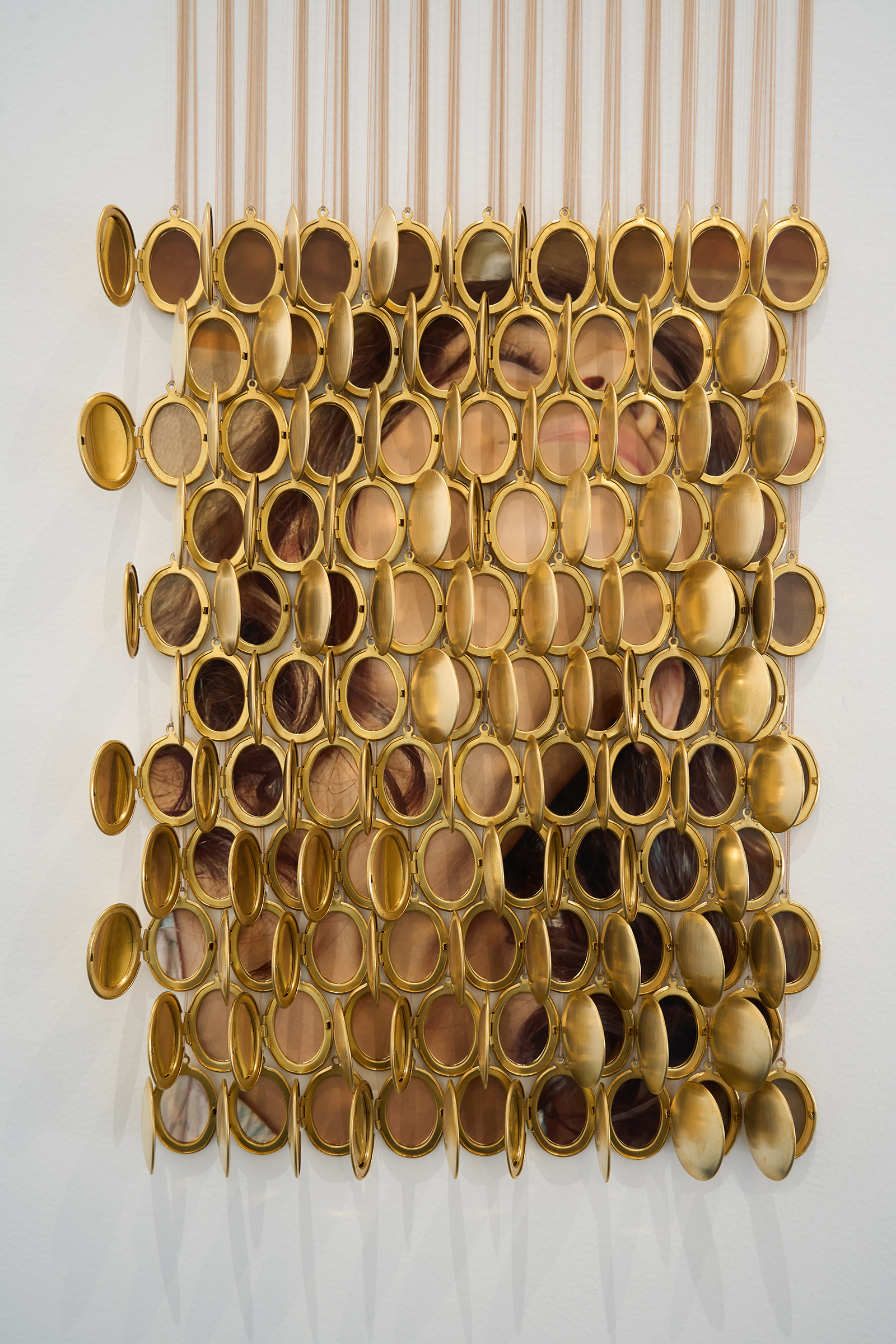
Brass locket pendants, poly-cotton thread, print on archival photographic paper
Escobar Saavedra pushes ordinary objects against the fluid threshold between bureaucratic and emotional registers. In CELESTE, she reflects on how the small portrait of a loved one has been carried and treasured through centuries as a trace of existence and memory. The work draws on the tradition of the oval locket—an archetypical form that has historically served as a wearable container for sentiment, a fragment of a person carried close to the body. A meditation on form and the mechanics of seeing, the photographic portrait is fractured into multiple parts that can only be read as a whole from a distance.
Escobar Saavedra’s practice articulates how tools of identification and control mirror memorial objects in both form and function. CELESTE is part of her ongoing investigation into containers of identity, focusing on notions of preciousness and value, and on how memory is held in material form.
AURORA
2025
Created in collaboration with Spencer Shea and Arthur du Peuty in Fujairah on March 26 at 6:10 am.
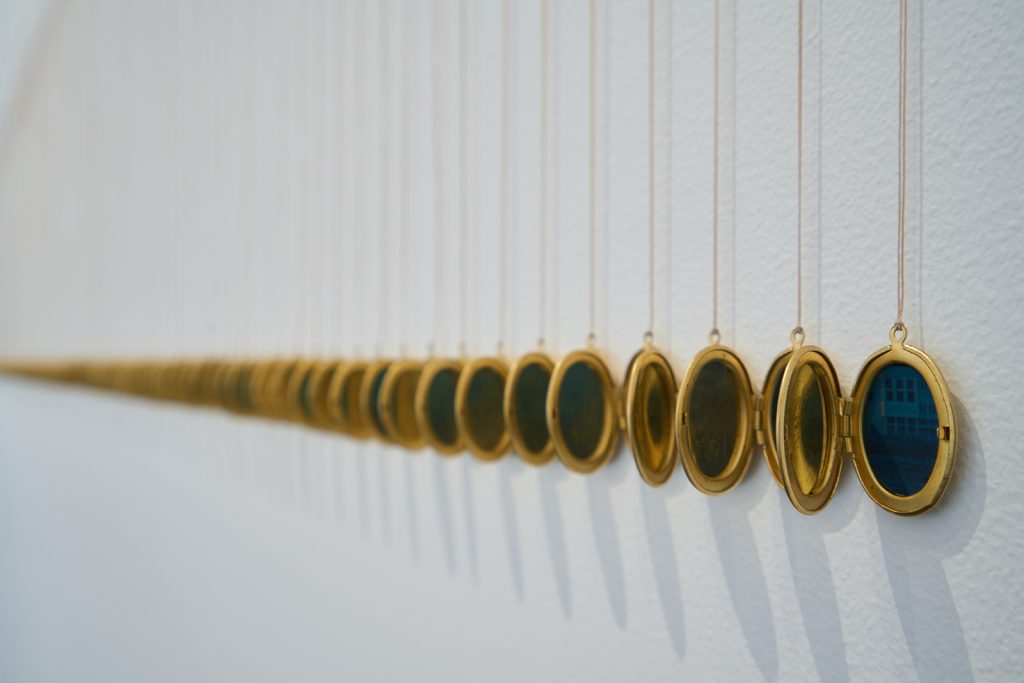
AURORA forms a line of metal pendants suspended along a wall, each containing a fragment of a single panoramic image taken at sunrise as a metaphor of birth and tabula rasa. Together, the lockets form a segmented horizon, with the full image only legible from a distance.
The locket, a form historically associated with intimacy and preciousness, is mass produced, multiplied and repositioned in this work. Detached from the body, it becomes both structural and serial.
Escobar Saavedra’s practice observes things and events seemingly ordinary, overlooked, rituals of the mundane, gestures and repetition, engaging with the cyclical nature of existence
BECOME
2023
This work was prompted by a 2021 lecture in which curator and researcher Mónica Gaspar described her hospital bracelet as her first piece of jewelry. Escobar Saavedra, who had kept the birth tags of her own children, began to consider their symbolic and material weight: placed on the naked body of a baby before being handed back to the mother. What began as a tool to differentiate infants in clinical settings, also serves as a plaque for the first legal marker, linking the newborn to state systems of recognition.
BECOME is the to-scale reproduction of the artist’s son hospital birth tag, typically produced in plastic and marked with a newborn’s details. By reworking this object in granite, cut, shaped, and left blank, Escobar Saavedra reflects on how identity is first assigned and later carried. The name both a label and legacy, given before having consciousness of our own existence, becomes a thread that stretches across a lifetime, appearing physically and digitally on documents, certificates, contracts, and gravestones.
This piece is foundational to the artist’s ongoing engagement with how standardized identifiers signal belonging across private, administrative, and historical domains.
POROUS
2023–2025
POROUS brings together stone carvings, printed matter, etchings, photographs, and sound into an open-ended catalog or repository.
Escobar Saavedra examined her own official records and documents that trace movement, identity, and the passing of time. The objects are displayed as a constellation of personal and bureaucratic forms, standard-sized objects, containers, and vessels, suspended between utility and memorial.
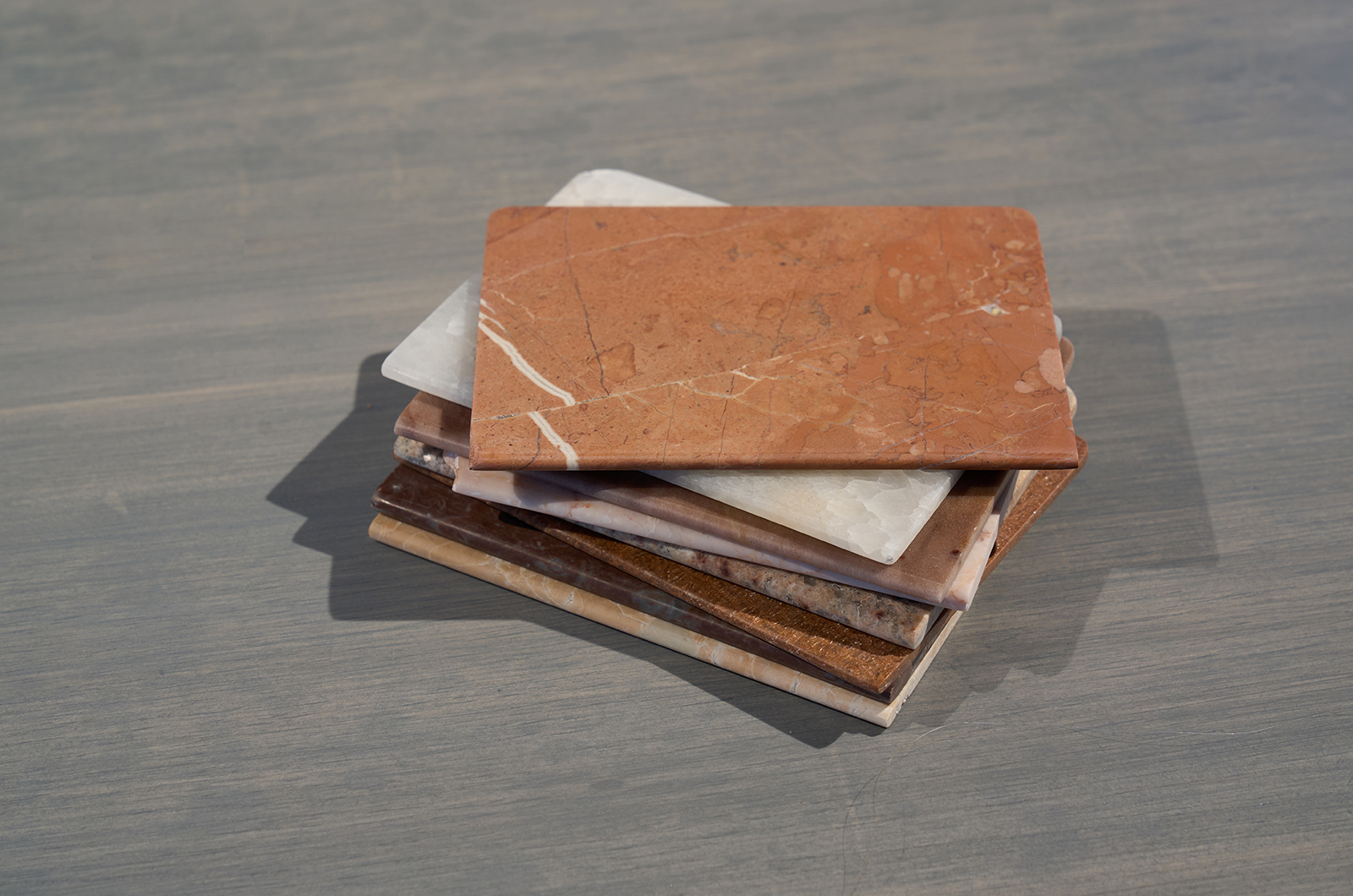
The stones used in the installation were gathered over two years, including discarded industrial remnants and rocks found or gifted by others. Some are patiently hollowed into box-like forms, others mimic familiar templates: ID cards, photos, certificates, letter-sized sheets. The contents are removed, leaving only shape, material, and trace.
INSTANT
2025
INSTANT replicates standard ID photo contact sheets, referencing both photomaton prints and International Civil Aviation Organization (ICAO) compliant passport images. The format, which is designed for legibility, recognition, and control, is slowed down and emptied through the act of carving. The stone, dense and textured, holds the absent image through weight and form rather than likeness.
These small portraits that belong to the bureaucratic and political systems often linked to movement and migration can sometimes end up treasured in coffrets or carried in wallets transcending the initial function into an emotional object.
Thinking of the photo as a medium and as an object, in this work, the artist isolates a familiar tool of documentation and repositions it within a material vocabulary associated with permanence and memorial.