Lawrence Abu Hamdan: Sound and Nothing More: Scoring the Contemporary
TIMINGS
Lawrence Abu Hamdan: Sound and Nothing More: Scoring the Contemporary
What does catastrophe sound like? Can we hear the past in the present? What might it mean to score the contemporary as future perfect?
The artist and forensic investigator Lawrence Abu Hamdan has been researching and exhibiting the distinct capacity of sound to articulate presence and absence at once.
Lawrence Abu Hamdan: Sound and Nothing More: Scoring the Contemporary
What does catastrophe sound like? Can we hear the past in the present? What might it mean to score the contemporary as future perfect?
The artist and forensic investigator Lawrence Abu Hamdan has been researching and exhibiting the distinct capacity of sound to articulate presence and absence at once. For instance, in his work on the Saydnaya prison in Syria, he demonstrates how the invisible, diffuse nature of sound reverberations without a source redoubles linear mechanisms of panoptic control that rely on direct lines of sight: torturer and tortured, warden/observer and prisoner/observed. Sounds of the torturers, the tortured, footsteps (wardens or prisoners?), and a creaking infrastructure saturate prisoners’ bodies and minds with horror (Saydnaya (the missing 19db) 2017). For the colloquium, we’ve asked Lawrence to present his more recent work on reincarnation (current), considering the relation between past, present, and future temporalities through sound loops open and closed.
About the speaker:
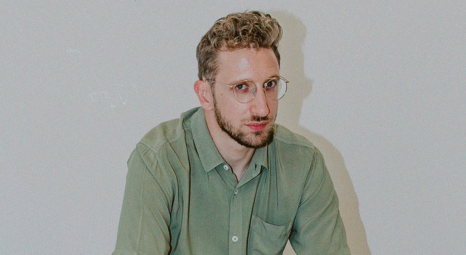
Lawrence Abu Hamdan is a ‘private ear’ and artist interested in the relation between sound and politics. His audio investigations have been used as evidence at the UK Asylum and Immigration Tribunal and political advocacy with Forensic Architecture. He was awarded the 2019 Turner Prize.
Future Perfect is a colloquium bringing together curators, artists, and scholars to flesh out the contemporary along a Möbius strip of past and future, distance and proximity, absence and presence, catastrophe and creation, displacements and condensations of time and space in the historical landscape of modernity. How might we think, produce, and exhibit the contemporary in modernity and vice-versa? — towards social and political justice through aesthetic invention and intervention?
This colloquium is part of Warehouse421 Curatorial Development Exhibition Program, in partnership with Bombay Institute for Critical Analysis and Research (BICAR).