Ala Younis: Curating Contemporary Archives
TIMINGS
Ala Younis: Curating Contemporary Archives
Since the onset of modernity, ‘the archive’ has taken center stage in contemporary situations of crisis and transformation, in both private and public life. Today, as catastrophe repeats with near compulsion, archives are everywhere, across academic disciplines, art media and exhibitions, indeed archives have become the stuff of our urban built forms. What do we do with contemporary archives in modernity? And what does the ubiquity of the archive do to/for us? How might we rethink our approach to ‘curating contemporary archives’?
About the speaker:
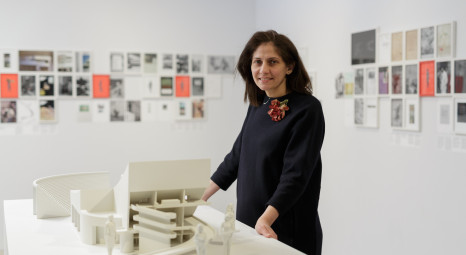
The curator and artist Ala Younis exhibits work that stitches together ‘evental’ experiences of recurring crises across the world, as well as between time– the past, present, and future. An Index of Tensional and Unintentional Love of Land (2014) exhibits the particular instance of Palestinian struggle– from the nakba to the naksa until the contemporary crisis– in relation to other revolutionary events, accomplisments, and disappointments. Juxtaposing images, built-forms, photographs, cinema, and archival documents of visual culture that undermine stereotypical particularizations of crisis and its replies in a global world order, Ala literally exhibits a revolutionary international of presence and absence in the same space-time: what is missing from here that is present elsewhere, what was done then that is being done now, and vice-versa? She uses the exhibition space-form to put geographies and temporalities in rigorous conversation with one another.
Future Perfect is a colloquium bringing together curators, artists, and scholars to flesh out the contemporary along a Möbius strip of past and future, distance and proximity, absence and presence, catastrophe and creation, displacements and condensations of time and space in the historical landscape of modernity. How might we think, produce, and exhibit the contemporary in modernity and vice-versa? — towards social and political justice through aesthetic invention and intervention?
This colloquium is part of Warehouse421 Curatorial Development Exhibition Program, in partnership with Bombay Institute for Critical Analysis and Research (BICAR).