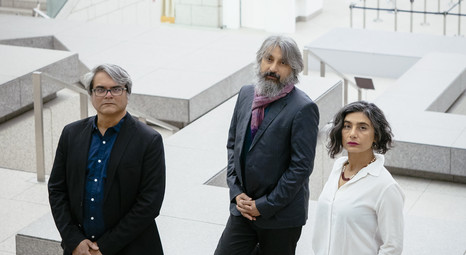
Raqs Media Collective: Catastrophic Anesthesia: Immunities and the Promise of Community
TIMINGS
Raqs Media Collective: Catastrophic Anesthesia: Immunities and the Promise of Community
Raqs Media Collective turn against soothsaying by conceptualizing the infinite, the impossible as necessarily present, not as that which awaits us in some determinate, post-apocalyptic future (The Necessity of Infinity, 2017). Raqs work on the contemporary as always-already pathological, the apocalypse as having happened, and toxicity as the structure of the present that begs dismantling (Toxicity, current).
Raqs Media Collective: Catastrophic Anesthesia: Immunities and the Promise of Community
Raqs Media Collective turn against soothsaying by conceptualizing the infinite, the impossible as necessarily present, not as that which awaits us in some determinate, post-apocalyptic future (The Necessity of Infinity, 2017). Raqs work on the contemporary as always-already pathological, the apocalypse as having happened, and toxicity as the structure of the present that begs dismantling (Toxicity, current). The collective was formed in 1992 in Delhi — a time of the ‘great Indian’ opening of capital to the rest of the world — and the word ‘raqs’ registers the double meaning of revolution: a whirling return to the same as well as the production of difference through that repetitive return. A ‘kinetic contemplation’, Raqs has produced restless entanglement with the world and time with a celebrated practice across several media: installation, sculpture, video, performance, text, lexica, and curation.
About the speaker:
Raqs Media Collective was founded by Monica Narula, Shuddha Sengupta, and Jeebesh Bagchi in 1992. Conjuring figures of cognitive and sensory acuteness, their work reconfigures perceptual fields and demands that everyone looks at what they take for granted, anew. They’re presently working on toxicity and friendship.
Future Perfect is a colloquium bringing together curators, artists, and scholars to flesh out the contemporary along a Möbius strip of past and future, distance and proximity, absence and presence, catastrophe and creation, displacements and condensations of time and space in the historical landscape of modernity. How might we think, produce, and exhibit the contemporary in modernity and vice-versa? — towards social and political justice through aesthetic invention and intervention?
This colloquium is part of Warehouse421 Curatorial Development Exhibition Program, in partnership with Bombay Institute for Critical Analysis and Research (BICAR).