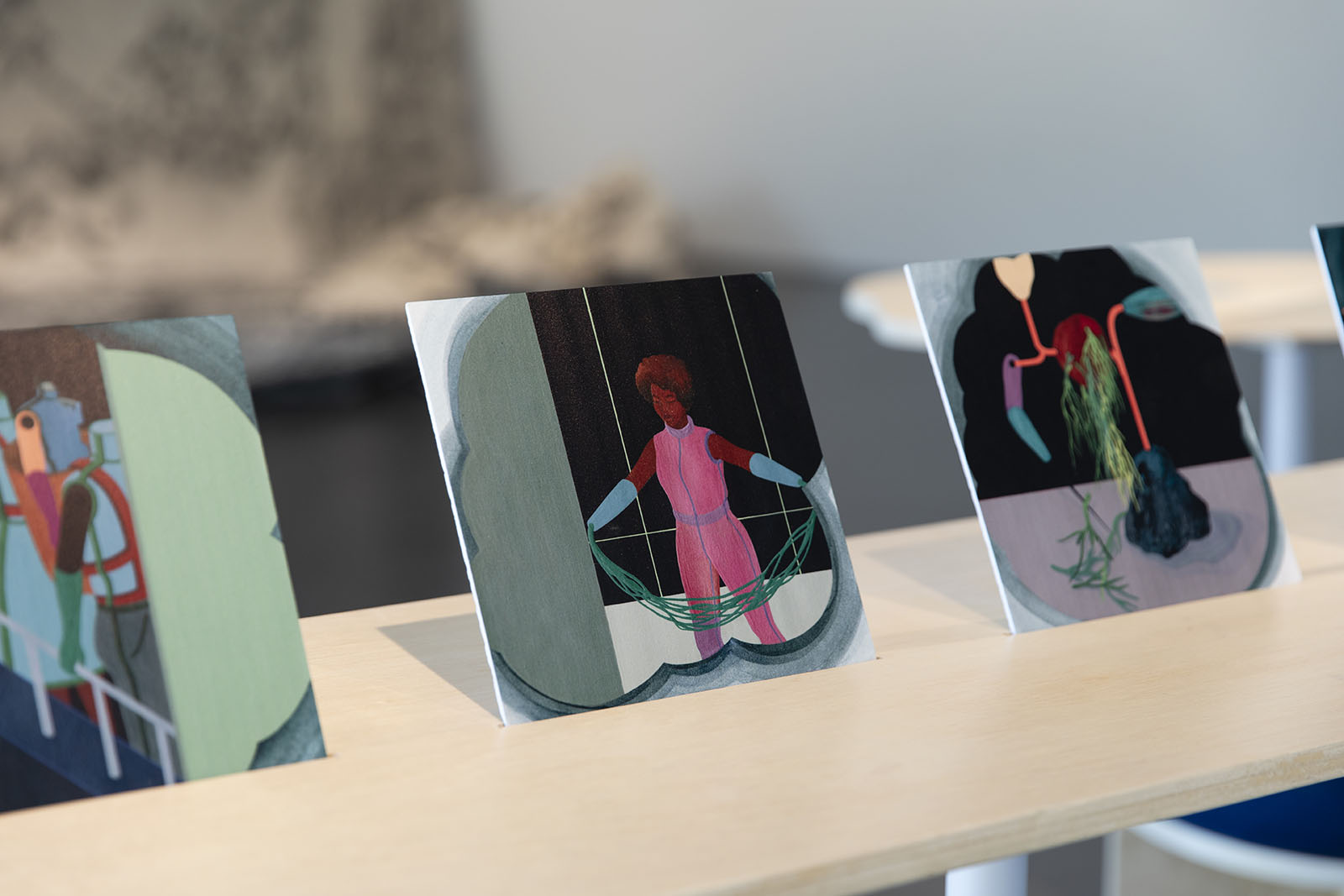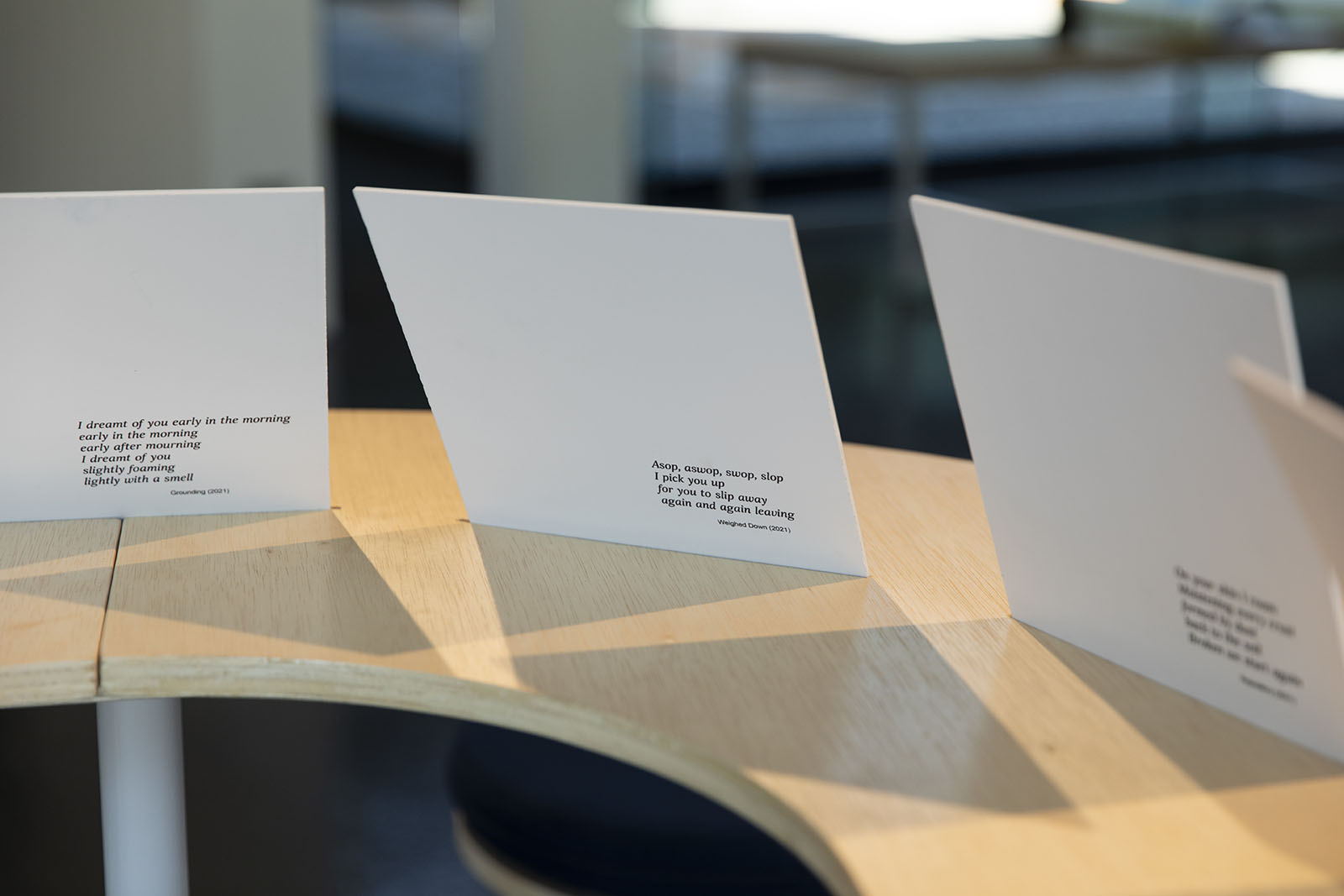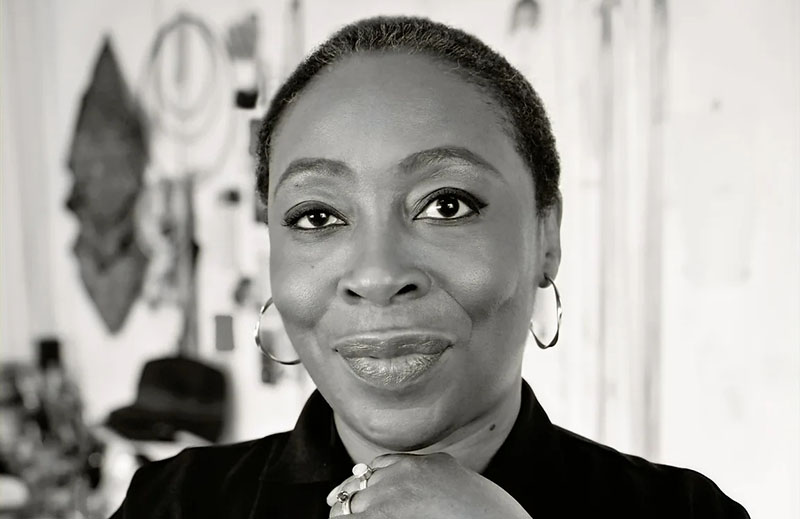
Otobong Nkanga (b. 1974, Nigeria) is an Antwerp-based artist. Her practice raises questions about the historical structure of a place, both physically and metaphysically. She often refers to the different objects and elements in her work as constellations. Constellations are imaginary patterns or diagrams which allow her to chart the intersections of nature, politics, colonialist economies and different geographies and histories.
Nkanga’s most recent solo exhibitions include Craving for Southern Light, IVAM Centre Julio González, Spain (2023), Gently Basking in Debris, Nashville TN (2023), Underneath the Shade We Lay Grounded, Sint-Janshospitaal, Bruges (2022), Otobong Nkanga, Kunsthaus Bregenz, Bregenz (2021-2022), Of Cords Curling around Mountains, Castello di Rivoli, Rivoli (2021-2022), When Looking Across the Sea, do you Dream?, La Villa Arson, Nice (2021), Uncertain Where the Next Wind Blows, Henie Onstad Kunstsenter, Høvikodden (2020-2021), There’s No Such Thing as Solid Ground, Martin-Gropius-Bau, Berlin (2020), From Where I Stand, Middlesbrough Institute of Modern Art (MIMA), Middlesbrough (2020-2021), Acts at the Crossroads, Zeitz MOCAA, Cape Town (2019), From Where I Stand, Tate St. Ives, St. Ives (2019), A Lapse, a Stain, a Fall, Ar/geKunst, Bolzano (2018); To Dig a Hole that Collapses Again, Museum of Contemporary Art (MCA), Chicago (2018); Voices (Wetin You Go Do?), The Tanks at Tate Modern, Blavatnik Building, London (2017); The Breath from Fertile Grounds, Temple Bar Gallery, Dublin (2017); The Encounter That Took a Part of Me, Kunsthal Aarhus, Aarhus (2017); The Encounter That Took a Part of Me, Nottingham Contemporary, Nottingham (2016); MATRIX 260, University of California, Berkeley Art Museum and Pacific Film Archive (BAMPFA) (2016); Landversation Beirut, Beirut Art Center (2016); Diaoptasia, Tate Modern, London (2015); Bruises and Lustre, Museum voor Hedendaagse Kunst Antwerpen (M HKA), Antwerpen (2015); Comot Your Eyes Make I Borrow You Mine, Kadist Art Foundation, Paris (2015); Crumbling Through Powdery Air, Portikus, Frankfurt (2015).
Her work has been included in institutional group exhibitions as the 58th Venice Biennial, Venice; Black Refractions, San Francisco CA, Charleston SC, Kalamazoo MI, Northampton MA, Seattle WA, Salt Lake City UT (2019-2020); Hand Drawn, Action Packed, Hayward Gallery Touring, St. Albans, Wolverhampton, Glasgow, Swansea (2018-2019); Laid Bare in the Landscape, Nevada Museum of Art, Reno (2018); Cosmogonies, au gré des éléments, Musée d’art moderne et d’art contemporain (MAMAC), Nice (2018) ; General Rehearsal, Moscow Museum of Modern Art, Moscow (2018); Documenta 14, Athens / Kassel (2017); I am a native foreigner, Stedelijk Museum Amsterdam (2017); Take Me (I’m Yours), Pirelli Hangarbicocca, Milan (2017); Life Itself, Moderna Museet, Stockholm (2016); Museum on/off, Centre Pompidou, Paris (2016); 13th Biennale de Lyon, La vie moderne, Lyon (2015); 31st Bienal de São Paulo, São Paulo (2014), 8th Berlin Biennale, Berlin (2014).
Additionally, works have been acquired by public collections as Museum of Modern Art (MOMA), New York; Musée d’Art Moderne de Paris, Paris; Fondation Beyeler, Riehen; Kunsthalle Mannheim, Mannheim; Museum Brugge, Bruges; Kröller-Müller Museum, Otterloo; TextielMuseum, Tilburg; Art Gallery of Ontario, Ontario; Centre Pompidou, Paris; Tate Modern, London; Museum voor Hedendaagse Kunst Antwerpen (M HKA), Antwerpen; Hammer Museum, Los Angeles; Middlesbrough Institute of Modern Art (MIMA), Middlesbrough; Denver Art Museum, Denver; Hessel Museum of Art, New York; Bonnefantenmuseum, Maastricht; Inhotim Museum, Brumadhino; KANAL – Centre Pompidou, Brussels; Henie Onstad Kunstsenter, Høvikodden; Swiss Institute / Contemporary Art, New York; Frans Hals Museum, Haarlem; Castello di Rivoli Museo d’Arte Contemporanea, Turin; Minneapolis Institute of Art, Minneapolis; Stedelijk Museum Amsterdam, Amsterdam; Museum Arnhem, Arnhem; Kiasma Museum of Contemporary Art, Helsinki; Studio Museum Harlem, New York; Weltkulturen Museum, Frankfurt; Nevada Museum of Art (NMA), Reno; Queensland Art Gallery – Gallery of Modern Art, Queensland; Kadist Art Foundation, Paris; Stedelijk Van Abbemuseum, Eindhoven; Mu.ZEE, Oostende; Centre National des Arts Plastiques (CNAP), Paris; Museum Folkwang, Essen; Rabo Art Collection, Utrecht; Robeco Art Collection, Rotterdam; Fondation Sindika Dokolo, Luanda; AkzoNobel Art Foundation, Amsterdam; Société Générale Art Collection, Paris; FRAC Ile-de-France, Paris; FRAC Bretagne, Rennes; FRAC des Pays de la Loire, Carquefou; FRAC Provence Alpes Côte d’Azur (PACA), Marseille; FRAC Lorraine, Metz; FRAC Corse, Corse.
Otobong Nkanga is the 1st recipient of the Lise Wilhelmsen Art Award (Norway, 2019), and was awarded the Peter Weiss Award (Bochum, 2019), the Special Mention Award of the 58th International Art Exhibition of La Biennale di Venezia (Venice, 2019), the 2019 Sharjah Biennial Award (Sharjah, 2019), the Flemish Cultural Award for Visual Arts – Ultima (Brussels, 2018), the Belgian Art Prize (Brussels, 2017) and the 8th Yanghyun Art Prize (Seoul, 2015).
She currently lives and works in Antwerp, Belgium.