Ecopedagogy is the guiding principle in Karachi LaJamia’s practice, where pedagogy is understood as a mode of connection and collectivity—a practice for building and mending relations with one another and with the environment. Cultural research thus is an ecstatic, mystical, and relational process of encountering and engaging an other—a person, a community, a lake, a cluster of trees.
The nomadic space or anti-institution was founded by artists and educators Shahana Rajani and Zahra Malkani. Since 2015, in collaboration with community and activist organizations across Karachi, they have facilitated a series of site-specific courses and collaborative research projects to explore the intersections of militarism, land accumulation, climate crisis, indigenous dispossession, and assembling dispersed practices centering indigenous knowledges and genealogies of resistance.
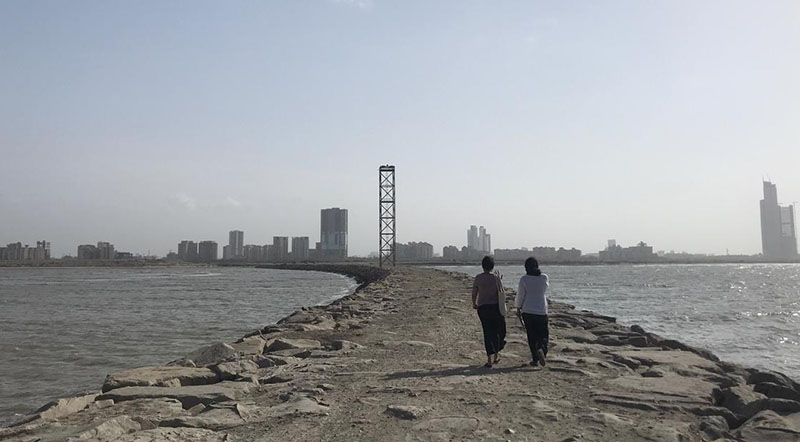
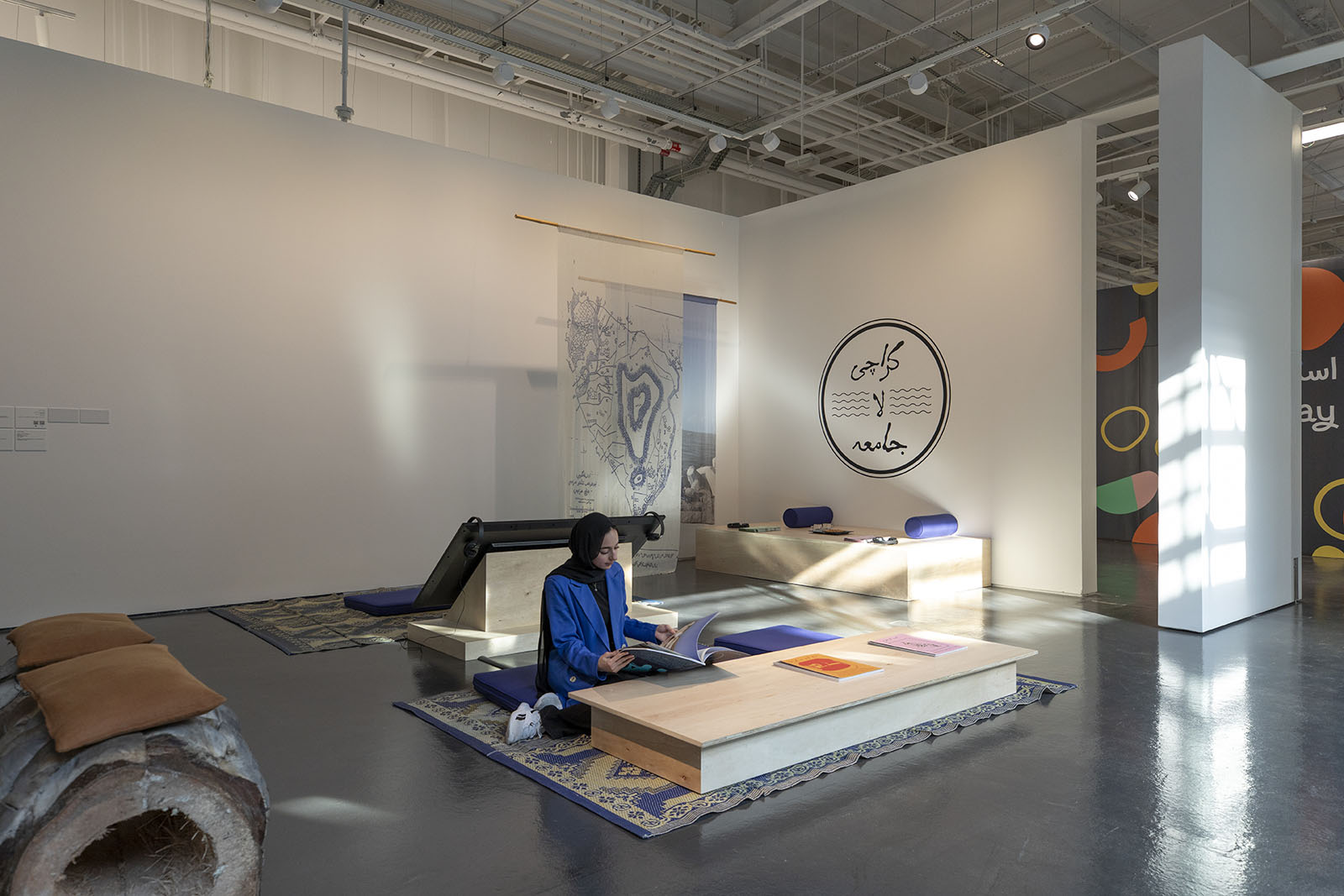
They write: “The English word Jungle derives its root from the Sanskrit Jangala–dry land. The imaging of dry, arid land as abject, unproductive, and unsafe is an enduring colonial legacy in Karachi; it is also deployed alongside a systematic drying of Karachi’s wetlands through extractivist practices like sand mining and construction into riverbeds and waterways. Countering this colonial narrative, Karachi LaJamia has conducted their ecstatic ecopedagogies in the dry/wet/land that they found instead to be a rich, fertile, and bountiful plain.” Their multi-media installation titled Ecopedagogy (2023) revisits and redesigns their almost a decade-long vast archive, which includes experimental publications, video works, scholarly texts, browser-based artwork, syllabi and workbooks, and an expansive archive of fieldwork: audio, video, photographs, and maps.
A space of gathering and collective witnessing, the installation alludes to architectures like community libraries, roadside dhabas, boats and autaaks situated within landscapes where ancient ecologies and new, violent infrastructures exist side by side.