لا توجد منتجات في سلة المشتريات.

يجر

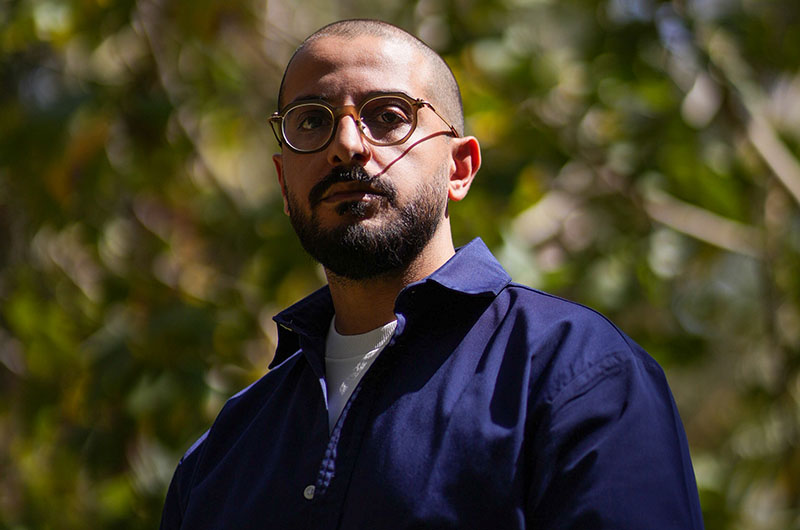
Ayman Zedani

Ayman Zedani’s (b.1992, Saudi Arabia) investigative practice works to upend our comprehension of the past and challenge our acceptance of the future. His work includes videos, installations and immersive environments that consider the future of the Gulf. His resultant projects are platforms to invite audiences to observe human-nonhuman symbiosis, leaving his narratives open to a multitude of interpretations and questions. His arc of inquiry highlights the interactions and relationships of humans in the more-than-human world, framing his practices and projects as extended animism.

The construction and consumption of nature in the Gulf are central to his explorative process, as well as elements of animist and polytheistic themes found in pre-Islamic Arabia, where non-human elements existed in harmony with humans. His themes of speculative futures move beyond the margins of Gulf Futurism and centralize the legacy of regional ecological and cultural lineage. His multi-layered projects are built on a series of experiments and investigations exploring multi-species collaboration and various forms of knowledge as a foundation to overcome the challenges of the Anthropocene.

Zedani’s recent projects include The Heavens Is For All, Islamic Arts Biennale, Jeddah (2023); The keepers, Staatliche Kunsthalle, Baden-Baden (2022); The Valley of the Desert Keepers, Desert X AlUla (2022); The Desert Keepers, Portrait of a Nation II, ADMAF (2022); Between Desert Seas, Diriyah Biennale, Diriyah (2021); a permanent installation titled Terrapolis, The Sustainability Pavilion, Expo 2020, Dubai (2020); Between the Heavens and the Earth, Lahore Biennial, Lahore (2020).
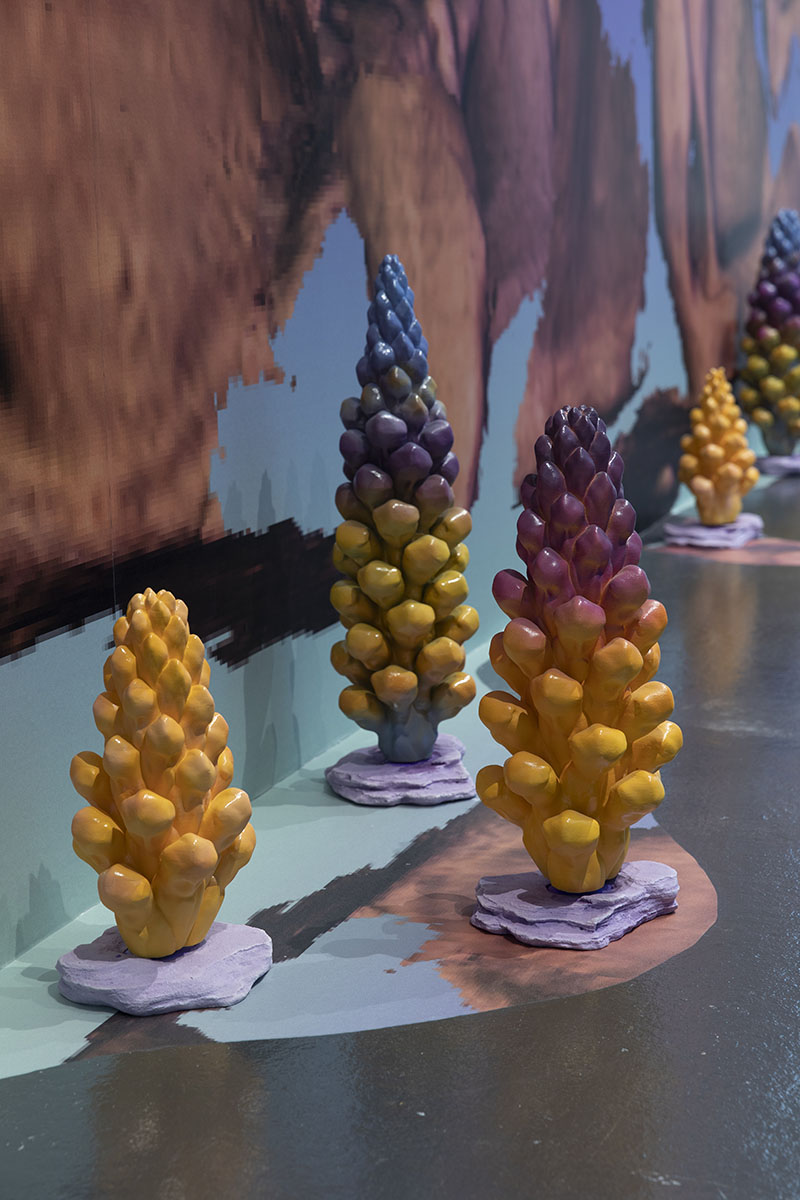
The Keepers
2022
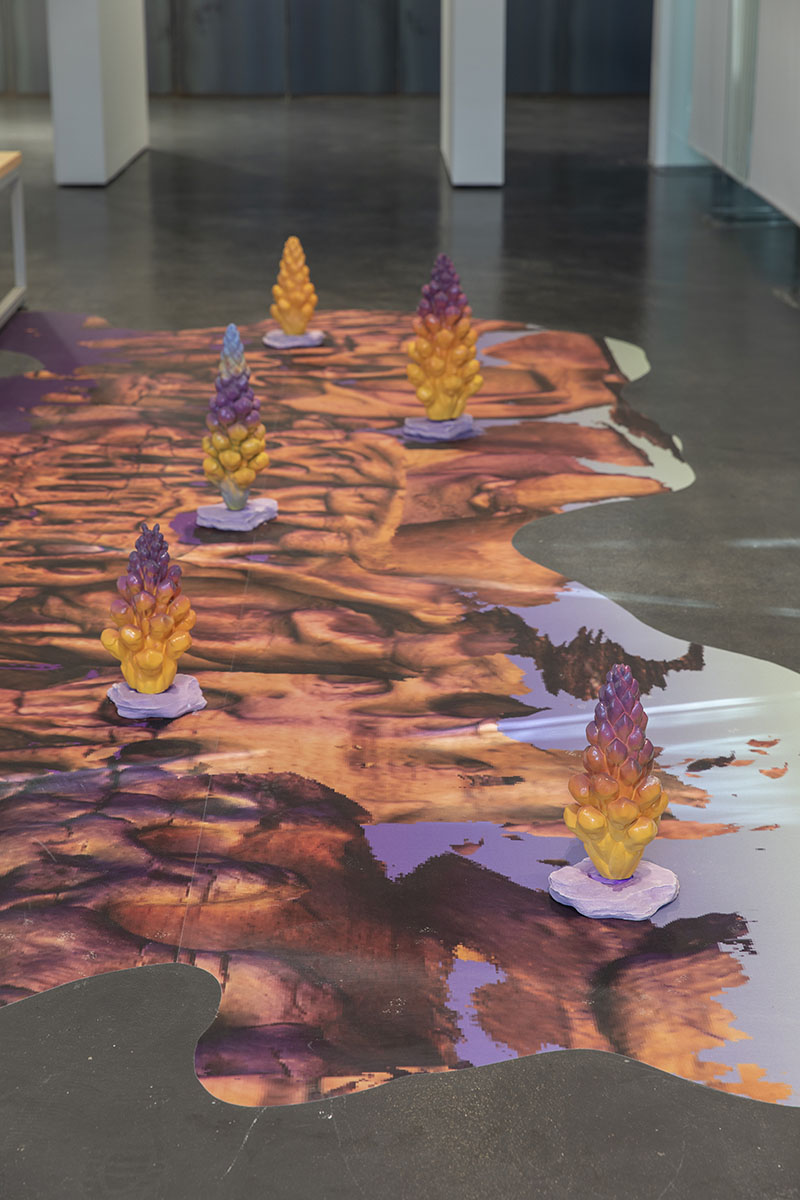
3D printed plant sculptures and wallpaper, produced locally
Dimensions variable

Courtesy of the artist

Do you see yourself here?

The Keepers convenes Ayman Zedani’s research on parasitic plants in the Arabian desert, DNA, and interspecies theories.

Modelled on specimens of the family Cistanche tubulosa found across deserts in the Gulf region, Zedani’s plant sculptures are re-imagined as hybrid iterations which have become keepers of extinct non-/human material and cultural ontologies, or ways of being. The desert itself is not merely a backdrop in The Keepers but an active accretion of time-spaces that compresses and rarefies across its dunes.

These plants imbibe the genes of various host plants through lateral gene transfer to make their offspring more resilient. Zedani has found ongoing research positing DNA as potentially the most efficient data-storage unit, estimating 1 gram of DNA can hold up to 215 petabytes (1 petabyte = 1 million gigabytes) of information.

In the context of the Anthropocene, and ongoing human and non-human extinction, such resilient plants could hold the DNA of multiple species, even when they themselves have become extinct. This could even extend to not only imbibing human genes but also holding archives of our histories in the post-extinction world.

The question that emerges is: what if human beings morph to the point of becoming phyto-morphic in the not-far future? More than a speculative narrative that merely fetishizes futurist fantasy, The Keepers parses the complex interstitial spaces of what extinction implies across species.

The Keepers asks us to unmoor our expected notions of anthropocentrism as well as the borders between the human and Nature, prompting a whimsical and ominous venture into territories of non-being.

النشرة الإخبارية