The girl with a star
2023
Wool tapestry
150 x 100 cm
Commissioned by 421
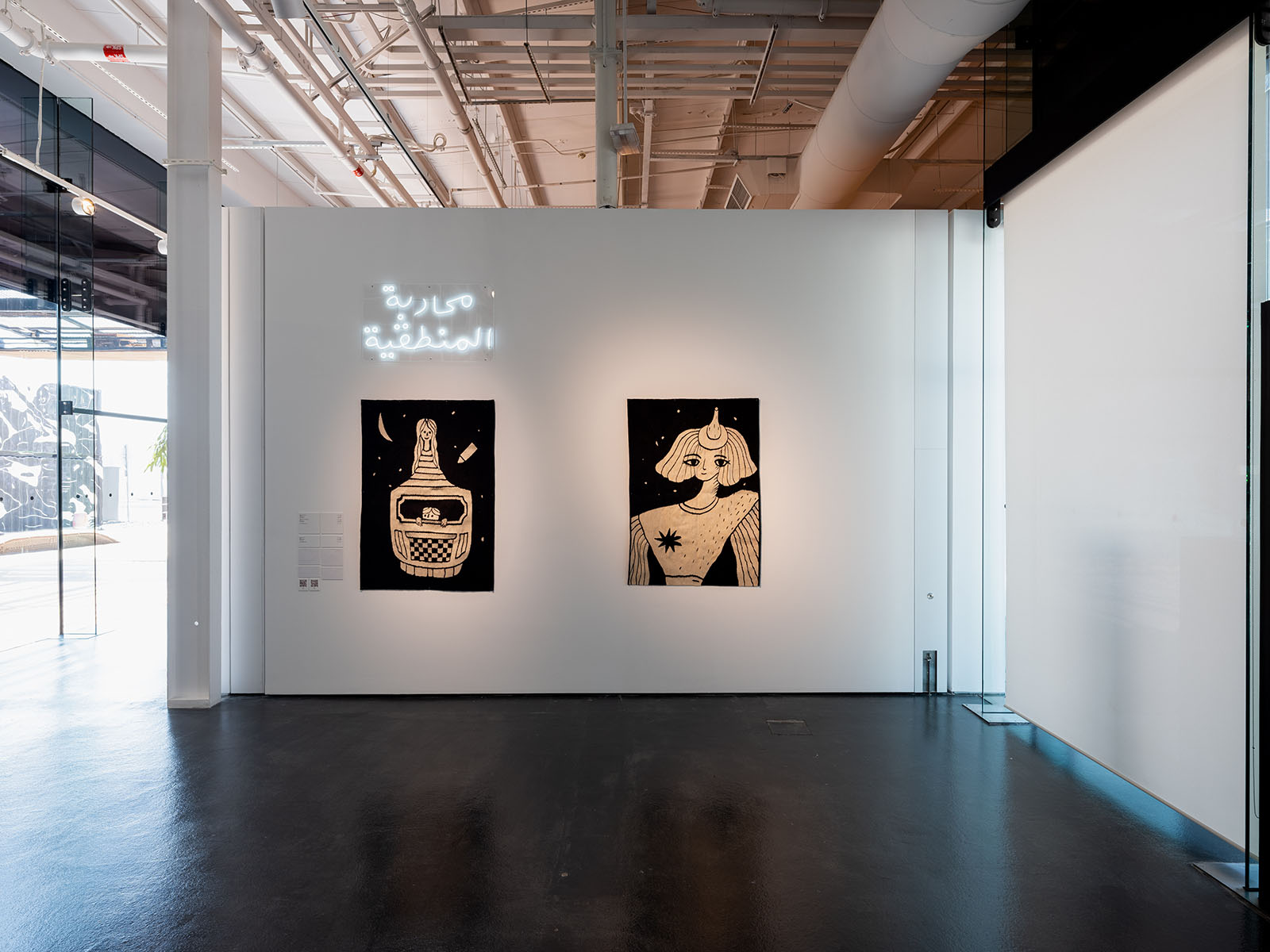
In this nonsense comic of Nasrallah’s, The girl with a star, a female character gazes out at us, wearing a kind of jumper with a star, the significance of which is unknown. The strands of the girl’s hair are stylistically echoed by Nasrallah in the sleeves of her garment.
Nasrallah’s unique portrait most dramatically reveals a surreal expression in the female character’s eyes, which appear larger than life. In an absurdist fashion, her eyes are indeed so large they cannot be contained within the outline of her face.
The boy in a living machine
2023
Wool tapestry
150 x 100 cm
Commissioned by 421
What if we designed our technological devices to resemble and behave like biological entities?
In The boy in a lving machine, Nasrallah imagines a world built on a symbiotic relationship between humans and our tools, where we connect with technology, rather than becoming alienated from it.
In this woven wool drawing, a boy, inside one of Nasrallah’s floating living machines, gazes outward to us. A female figure graces the top of the form, while a chess-like board faces outward, with shapes hovering in space around the machine.
Nasrallah’s woven wool textile was made in Egypt. While the initial drawing is mechanized, the tapestry maker, from the company Aiida, nevertheless creates a human-to-human connection in an otherwise mechanical process, working with fellow young weavers. |
Resisting Logic
2023
LED and acrylic
54 x 100 cm
Commissioned by 421
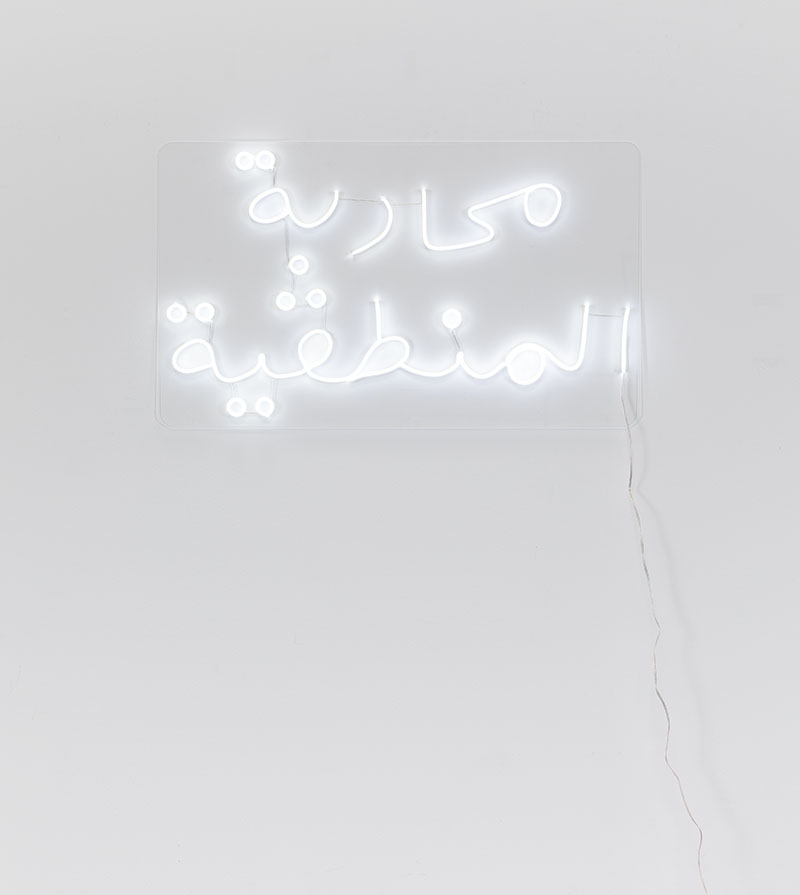
In the course of his practice, Nasir Nasrallah found two phrases he wrote in his sketchbooks: ‘resisting logic’ and ‘supporting randomness’. Nasrallah uses these phrases as a set of instructions on how he wishes we approach his body of work. These phrases have also been guiding principles to how Nasrallah approached this body of work.
Supporting Randomness and Resisting Logic are made with LED light. Creating compelling visual effects, LED light provides bright, energy efficient and durable light.
The main component of an LED is a semiconductor material known as ‘diode’. When electricity is applied to the diode, electrons loosen up from the surface of a diode while emitting packets of energy, referred to as ‘photons’ – which we can see as visible light. LEDs are available in different colour combinations because different semiconductor materials are able to produce different levels of energy.
Like famed conceptual artist Joseph Kosuth, Nasrallah’s phrases may draw inspiration from Ludwig Wittgenstein’s exploration of ‘tautologies,’ which are statements of fundamental truths that are irreversible and unchangeable.
In a 21st century landscape in which lexical slippage is the norm, Nasrallah’s LED works fuse the distance within words, uncovering the structures that underlie the things that humans do, think, perceive, and feel. |
Supporting Randomness
2023
LED and acrylic
54 x 100 cm
In the course of his practice, Nasir Nasrallah found two phrases he wrote in his sketchbooks: ‘resisting logic’ and ‘supporting randomness’. Nasrallah uses these phrases as a set of instructions on how he wishes we approach his body of work. These phrases have also been guiding principles to how Nasrallah approached this body of work.
Supporting Randomness and Resisting Logic are made with LED light. Creating compelling visual effects, LED light provides bright, energy efficient and durable light.
The main component of an LED is a semiconductor material known as ‘diode’. When electricity is applied to the diode, electrons loosen up from the surface of a diode while emitting packets of energy, referred to as ‘photons’ – which we can see as visible light. LEDs are available in different colour combinations because different semiconductor materials are able to produce different levels of energy.
Like famed conceptual artist Joseph Kosuth, Nasrallah’s phrases may draw inspiration from Ludwig Wittgenstein’s exploration of ‘tautologies,’ which are statements of fundamental truths that are irreversible and unchangeable.
In a 21st century landscape in which lexical slippage is the norm, Nasrallah’s LED works fuse the distance within words, uncovering the structures that underlie the things that humans do, think, perceive, and feel. |
The mirror that does not reflect you only
2023
Mirror, acrylic ink, antique frame
42 x 120 cm; 27 x 32 cm
Commissioned by 421
The mirror that does not reflect you only invites us into the world of Nasrallah’s floating living machines. Rendered upon a mirror, Nasrallah’s piece moves from the singular realm of symbolism, to become an interactive object that allows us to temporarily become part of the work.
With the earliest known mirrors dating from around 6200 BC in modern-day Turkey, mirrors have been a way to look inward, to grapple with complex ideas of identity and the gaze. The reflection in a mirror becomes a portal into an ‘anti-world’, a more truthful version of our own.
In thick blue colour, Nasrallah’s floating living machines gather together in a seemingly boundless, reflective space. By presenting his image in an antique wooden frame, Nasrallah highlights the contrast between that which is hand-made and his mechanical forms, while also giving a second life to these wooden frames.
Mirrors are a way of examining not only the self but wider society. The destruction of mirrors also points to the interconnectedness of society and the power that a reflection holds: no matter how many shards a mirror shatters into, it will always reflect back.
Rotation
2023
Ink and watercolour on paper
32 cm diameter, 3 pieces
Commissioned by 421
Nasrallah’s Rotation represents the ritual of community as we move throughout life. Rotation also compels us to reflect upon our social rituals, and what happens when we lose them.
Shared rituals play an important role in our psyches. Rituals, the choreographed events that produce an emotionally laden experience, create a feeling of unity and sacredness that bonds us together with others.
Gathered together in a circular formation, Nasrallah’s floating living machines hover in equidistant proportion to other machines, in a kind of a social dance.
When we participate in rituals, we experience an emotional contagion called ‘collective effervescence’, increasing our sense of commonality and making us feel we are part of a larger community. When we sheltered in place during the Covid-19 pandemic, we gave up important shared rituals, learning ways to create alternative events, which may have been more memorable than what was originally planned.
Nasrallah’s imagery inspires a renewed appreciation for shared rituals. By understanding the purpose of shared rituals, we can value them even more by creating moments that have a sense of shared emotion, connection, and transcendence.
The second life of used frames 01-07
2023
Pencil and marker colours on paper, used frame
24 x 29 cm; 22 x 32 cm; 35 x 27 cm; 13.5 x 17.5 cm; 18 x 23 cm; 18 x 22.5 cm; 21 x 16 cm; 28 x 27 cm
Commissioned by 421
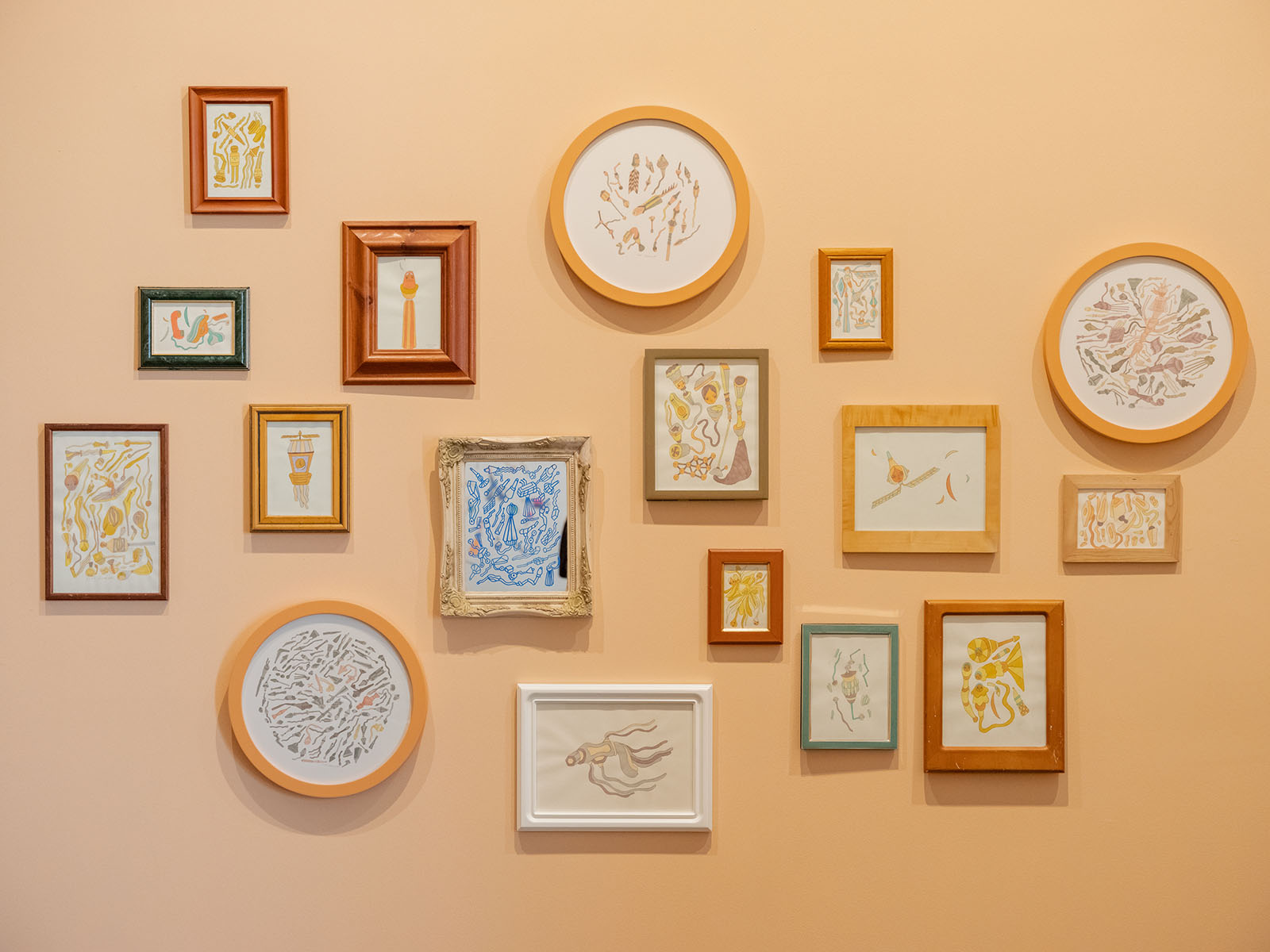
In The second life of used frames series, Nasir Nasrallah reveals and revels in the fascinating forms of his floating living machines. The works in this series present us with the banality of the spectacle. Figures smile. Figures seem to fly, float, and swim. Figures do silly things. Filled with utterances without linguistic sign, Nasrallah’s images in this series are filled with figures that give a sense of absurdity or randomness.
Nasrallah’s inimitable floating living machines freely roam across the picture plane and interact directly with us as autonomous life forms. Amongst machines that resemble life forms, we may feel a sense of awe rather than fear, a sense that these machines are fellow creatures, rather than alien beings.
Faxes to myself
2023
Fax machine, ring binder, facsimile papers
Dimensions variable
Commissioned by 421
Receiving his bachelor’s degree in telecommunication engineering from Khalifa University led to Nasir Nasrallah’s fascination with outdated communication tools like land-line telephones, fax machines, and typewriters.
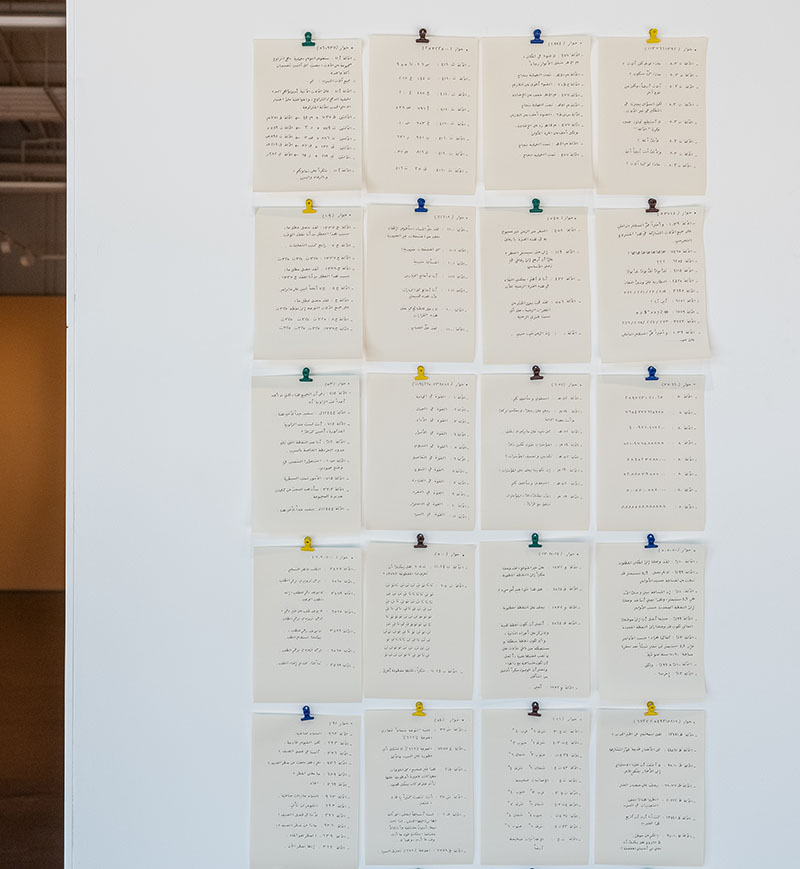
An interactive work presented as fax machine and an office binder, Faxes to myself reveals Nasrallah’s messages transmitted to himself via fax.
Short for ‘facsimile’, a fax is the telephonic transmission of scanned printed material to a telephone number connected to a printer. A fax machine processes the content as a single fixed graphic image, converted into a bitmap, and transmitted through the telephone system in audio-frequency tones. The receiving fax machine interprets these tones to reconstruct the image and print a paper copy. Widely used during the 1980s and 1990s, the fax machine was largely replaced by email and the internet.
Prior to this exhibition, Nasrallah sent himself stories, illustrations, and ideas via fax from his two art studios. Throughout the exhibition, the fax machine will receive fax transmissions which will fall to the ground in the gallery, periodically filed in within the wall-mounted cabinet.
You can send Nasrallah a fax as well; he will dutifully respond back via fax.
As a back-and-forth form of storytelling, the fax is an interesting object to Nasrallah: the received paper document contains both the original document as well as glitches or spots added in the process of transmission, seemingly like a coded message sent from the machine as the machine’s response. |
Space
2022
Acrylic on canvas
200 x 200 cm
Commissioned by 421
Nasrallah’s artistic practice reflects a mythical exploration of the relationship between humans and machines.
Space gives us a glimpse into one of Nasrallah’s richly detailed environments, populated with his floating living machines. Nasrallah encourages us to think about how we may live in a different environment, like a star-less space, and how it would differ from our daily lives here on planet Earth. Nasrallah’s floating living machines also invite us to consider the vast number of machines created by humankind for generations.
Completely self-taught, Nasrallah collects found objects, including outdated technology discarded for the new, like landline telephones and typewriters. These devices and others inspire Nasrallah to create floating living machines as unique objects.
Look carefully: although there are similar kinds of shapes, every floating living machine in Poetic of Machines is unique.
Nasrallah’s telecommunications engineering background feeds his adoration for the mechanical; Nasrallah states: “I want to pull apart machines and know how a mechanism works. You can apply mechanics to any part of life; even your personal life can be thought of as a machine.” |
Tribes of the living machines
2023
Ink and watercolour on paper
30 x 42 cm, 12 pieces
Commissioned by 421
Examining the intersection of technology and biology, in Tribes of the living machines, Nasrallah explores distinctions between animals and machines, and, in the process, questions what it means to be human.
Each of Nasrallah’s drawings in this series reflect a different tribe of floating living machines, moving together, each unique.
After millennia of agrarian civilization, humans remain stuck in tribal behaviour. Tribalism has its origins in our collective past, when belonging to a tribe meant protection from outside aggressors and a sense of identity.
Like Nasrallah’s tribes of floating living machines, we regularly exhibit tribal behaviours, from cliques in high school to sports fans wearing painted faces. While tribalism has been key to our survival, extreme tribalism creates a desperate attachment to a single-minded goal that causes a short-sightedness of the “other.”
Whether human or machine, Nasrallah recognizes this fundamental need to belong. With carefully rendered compartments, Nasrallah’s floating living machines appear as different tribes.
Regardless, we can follow value systems without closing off to different choices that others make. As Tribes of the living machines demonstrates to us, regardless of our tribe, we all share the same playing field. |
The comic of nonsense events
2023
Ink on paper
18 x 11 cm, 18 pieces
Commissioned by 421
A significant artistic influence of Nasrallah’s is manga artist Maki Sasaki (b. 1946). A pioneer of avant-garde experimental comics, Sasaki’s manga works defy a consistent narrative, delighting in randomness and difference instead. Sasaki provided coded comments on politics and history through the experimental use of the representational conventions of manga.
The comic of nonsense events pays unmistakable homage to Sasaki. In Nasrallah’s Sasaki-inspired nonsense comics, randomness and difference also deliberately work against any suggestion of consistent narrative. The specific mode of this style of comic drawing by Nasrallah contemporizes Sasaki’s style today.
An art of the sequential panel frame, manga is also a medium in which the speech balloon and the graphic representation of speaking bodies are central. Sasaki, however, encouraged blank speech balloons, known as ‘nansensu’. The Japanese transliteration of the English word ‘nonsense’, nansensu can also signal the absurd and the non-sequitur, as it did in nansensu gyagu, or ‘nonsense gag’ manga.
In this work, characters replicate and merge with Nasrallah’s floating living machines. Nasrallah’s images vary in their presentation to us, realized in a single image, or split into multiple sections, or panels.
Like Sasaki’s work before him, these parts contribute to a greater whole, as Nasrallah’s graphic forms transmit a semiotic experience unachievable in an alternate format. Nasrallah’s graphic images become signs, communicating something of meaning to us. This meaning can be intentional, or unintentional, and can also communicate feelings.
The flexibility of such symbolic imagery interpretation is well demonstrated in dreams. Nasrallah’s drawings, like dreams, rest on a blend of images and effects, as well as imagined sounds, words, and kinaesthetic, bodily sensations, leaving the meaning-making up to our interpretation of what we see and feel in response.
The previous thinking of the living machines
2023
Ink on paper
75 x 56 cm, 3 pieces
Commissioned by 421
The previous thinking of the living machines bridges Nasrallah’s previous artistic practice and his newer, machine-centric imagery, in conversation with his comic images.
Nasrallah imagines a world built on a symbiotic relationship between humans and our tools: a world where we connect with technology, rather than becoming alienated from it. The previous thinking of the living machines compels us to ask: what if our machines could be more than just our tools, and, instead, be a kind of companion species?
Nasrallah’s methods are ‘televisual’ in how they evoke the image stream of television programming, jumping from one unrelated advertisement to the next, then to a melodrama and then to a news program.
This evocation is all the stronger, as the imagery from The previous thinking of the living machines appears as if it could emanate from a black-and-white television set. |
The journey of living machines that are floating somewhere 01 – 02
2023
Ink and watercolor on paper
140 x 400 cm, 2 pieces
Commissioned by 421
Nasir Nasrallah provides us with a panoramic, detailed view of his fanciful floating living machines in The journey of living machines that are floating somewhere 01 and 02.
From the Greek words for “all” and “view”, a panorama is a wide-angle view or representation of a physical space. Rendered in ink and watercolour, these floating living machine forms float in a kind of organized formation across Nasrallah’s broad tableau. Remarkably, no shape is repeated: each machine is unique, like each of us.
Nasrallah’s focus here is on mechanical details, relating his imagery to early Islamic inventions and experiments. The marvellous creations of the 12th century Muslim inventor Ismail Al-Jazari laid the groundwork for modern engineering, hydraulics, and robotics. Al-Jazari gave the world a catalogue of his ‘matchless machines,’ known today as ‘The Book of Knowledge of Ingenious Mechanical Devices’.
Like Nasrallah, Al-Jazari included meticulous diagrams and colourful illustrations to show how all the pieces of his creations fit together. Centuries ahead of the achievements of European science, Al-Jazari‘s work on conical valves, a key component in hydraulic engineering, was first mentioned in Europe more than two centuries later by Leonardo da Vinci. |
Conversation
2023
Ink and watercolour on paper
400 x 100 cm
Commissioned by 421
In Conversation we are witness to what Nasrallah imagines a conversation between machines would ostensibly be. Neither logical or sensical, here, Nasrallah deliberately plays with the absurd. With the recent rise in Artificial Intelligence (AI) technology, Nasrallah’s subject of machines ‘conversing’ is prescient and timely.
Conversation recalls the familiar way a piece of paper emits from a fax machine or a Xerox copier, compelling us to read this message as one machine to another. When machines break down due to failed human-machine communications, they can cause small problems, or spectacularly large ones, such as leaving millions without power. or causing a nuclear reactor meltdown.
With increasing convergence between electronics systems, security, and communications, we are gaining the tools to overcome many of these complexities, as our safety depends on it. |
The Comet
2023
Wool tapestry
150 x 100 cm
Commissioned by 421
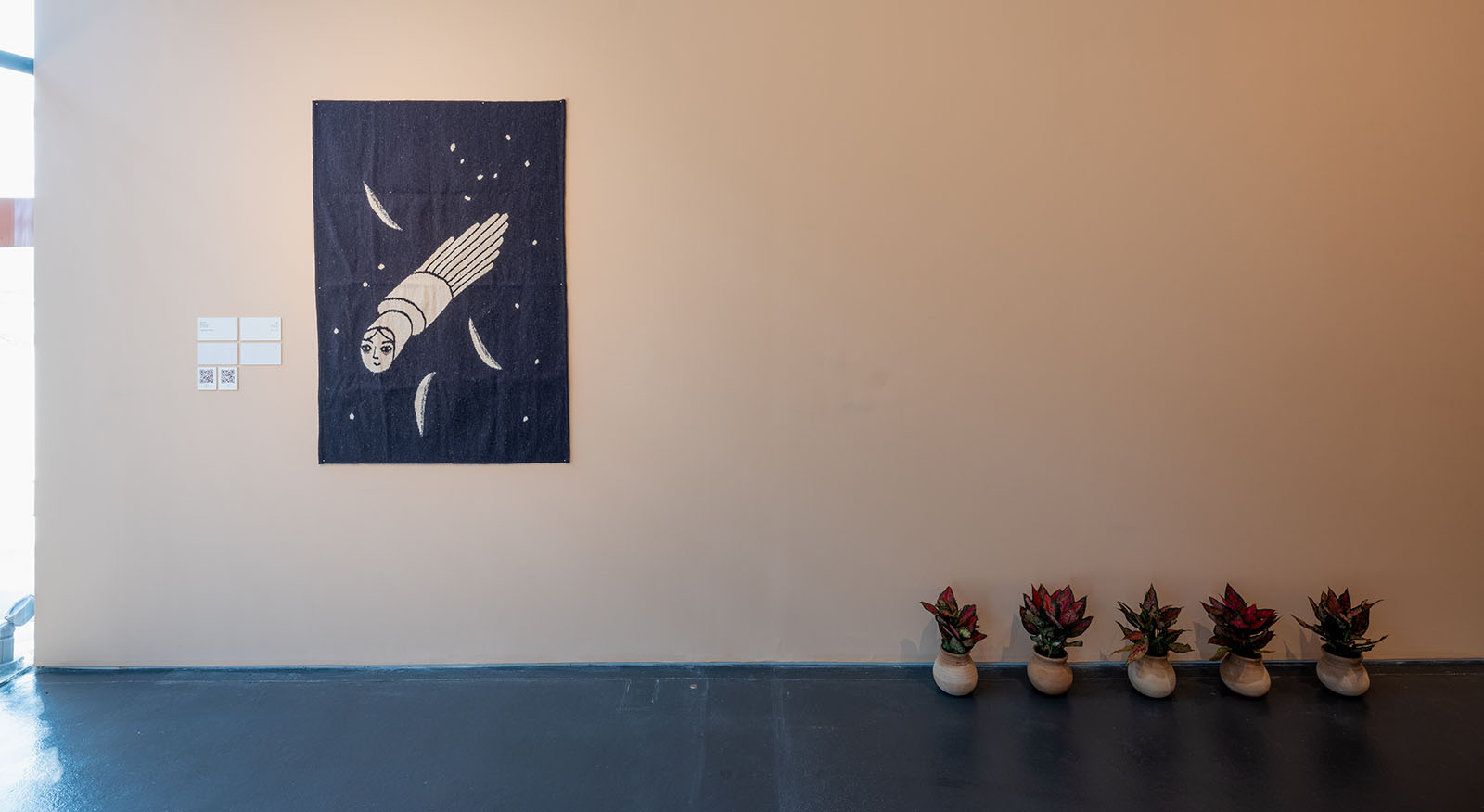
In The Comet, one of Nasrallah’s machines appears to have merged with a character, becoming the embodiment of a comet as a floating living machine.
As large objects made of dust and ice that orbit the Sun, comets are best known for their long, streaming tails. Comets are also ancient objects: they are leftovers from the formation of the solar system 4.6 billion years ago.
In The Comet, Nasrallah’s floating living machine propels itself toward us, bearing a kind, yet determined facial expression. Stars and slivers of crescent moon shapes surround The Comet as it traverses through space.
Some people think that there is no gravity in space. In fact, a small amount of gravity can be found everywhere in space.
The Comet demonstrates the concept of microgravity. Microgravity is the condition in which objects appear to be weightless, due to the effect of gravity being present yet quite small.
In microgravity, heavy objects like The Comet achieve the un-Earthly feat of moving around easily.” |
The Interaction
2023
Ink and watercolour on paper
75 x 110 cm
Commissioned by 421
As a boy, Nasrallah spent time tinkering with spare parts in his grandfather’s antiquities shop, at the Alarsa Souk in Sharjah. The shop’s clutter stood out to Nasrallah as something magical.
Inspired by the shapes, textures, and colours of found objects, and the vast machines created across the history of humankind, The Interaction presents Nasrallah’s trademark floating living machines as silent observers and receptacles with a life of their own.
Nasrallah feels we are surrounded by numerous machines, many of which work wonderfully yet are without any real benefit: we could live without them with any difficulty at all.
Short stories in the brown sketchbook
2023
Sketchbook
21 x 15 cm
Commissioned by 421
Short stories in the brown sketchbook collect Nasrallah’s hand-written, whimsical short stories and drawings. Nasrallah writes spontaneously in a way that may initially come across as child-like or playful, when in fact he is simply transcribing how his mind processes his reality. A reoccurring trope in Nasrallah’s artistic practice is the exploration of how modes of communication connect disparate places and times, even though individuals may be physically separated by great distances.
For Nasrallah, the capacity to bridge great intervals of time and place through modes of communication is integral to exploring notions of existence and matter.
Bound in leather, each story tells a unique tale. Writing philosophical, imaginative, unique, and surreal one-page stories, Nasrallah makes numerous mentions of not living things that have a living symbol in a playful way. The storys are symbolic, myth-like tales that ponder philosphical questions about life.
While addressing various communication systems and their impact on their surroundings, Nasrallah examines how these systems ultimately create new stories and imaginary worlds that circumvent conventional understanding of space and time.
Nasrallah’s machines seem to have a function but effectively they do nothing, inviting us to imagine the story behind the objects. Why are they here? What is link between them? How would they work if the machines were active?
Nasrallah’s machines inspire us to think about new ways of living with machines, and implore us to ponder how they could evolve into living creatures. |