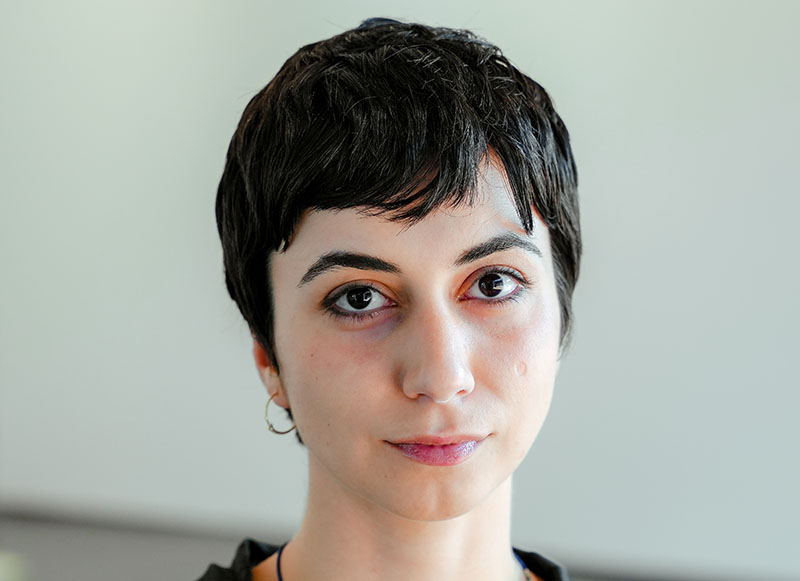
Mahshid Rafiei’s (b.1992, Tehran) work considers the ways a process, a material and an image can become so inextricable that they ossify projections of the imaginary. Her work has been exhibited at Fri Art Kunsthalle, Fribourg (2018) and Rheum Room, Basel (2018), among other spaces. Collaborative and discursive projects have been hosted at Mercer Union, Toronto (2020); Temporary Art Review, online (2016); and Knockdown Centre, New York (2013). She participated in March Meeting 2019: Leaving the Echo Chamber at Sharjah Art Foundation, and has held residencies at Spring Sessions, Amman (2019) and Darling Foundry, Montreal (2021).
Mahshid Rafiei
Project Title: Of Mythic Proportions
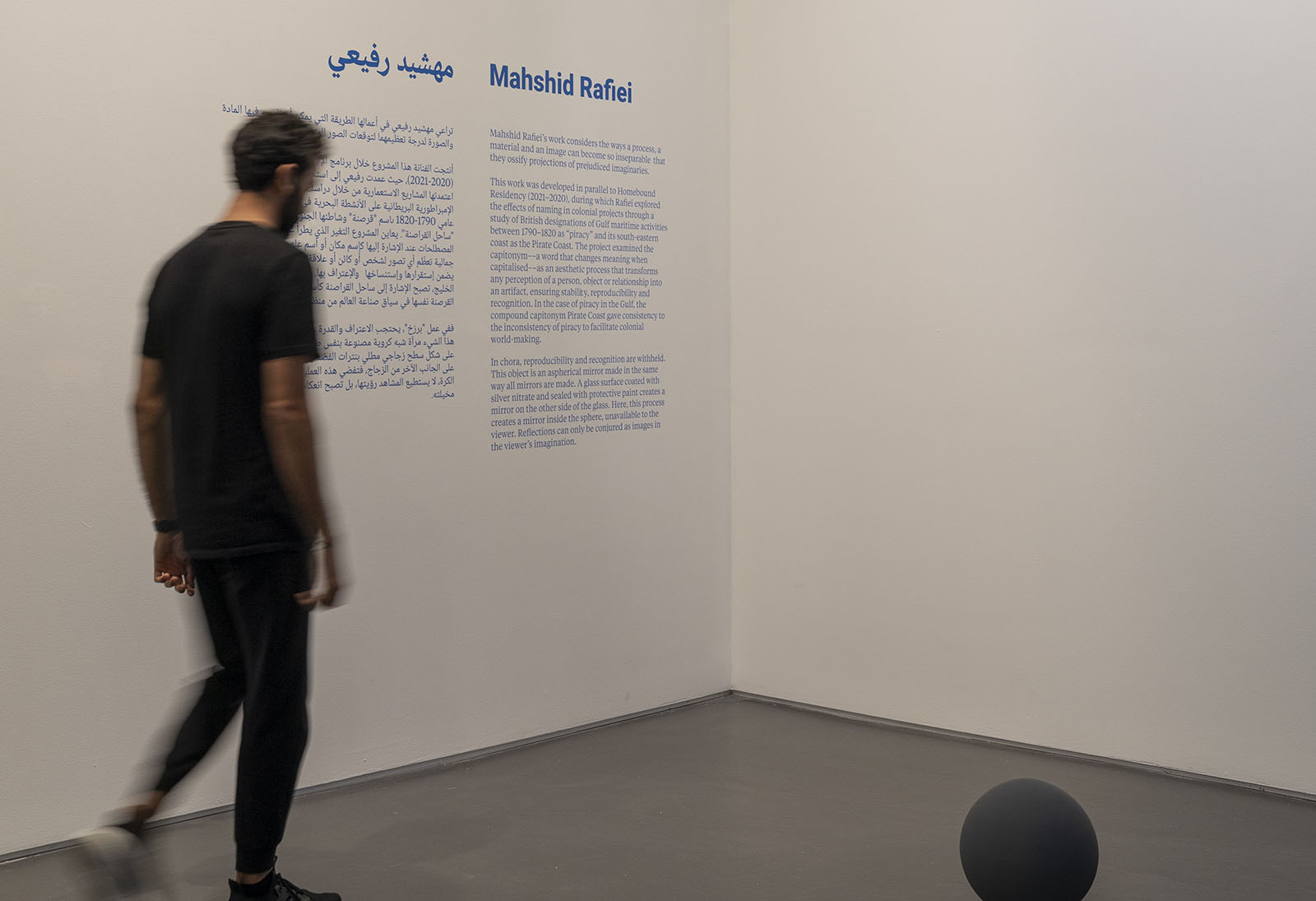
This project hinges on the myth of piracy in the Gulf during the 18th and early 19th century, when its southern coast was named the ‘Pirate Coast’ by the British to delegitimize indigenous Gulf rulers and to expand their territorial and commercial rule from the Indian Ocean to the Gulf. It is an exploration of the effects of naming in colonial projects and, specifically, the use of capitonyms to ossify racialized perceptions in the imagination. It attempts to identify a genealogy of attendant prejudices latent in language, while thinking through piracy as a non-conformist history alternative to hegemonic history. The project includes an ongoing study of the history of British interventions in the Gulf in relation to naming, myth-making, and image-making as tools that facilitate the formation of the colonial imaginary.
The study begins with the history of the Gulf between 1760 and 1850, focusing more closely on the pivotal period at the turn of the 19th century (1790–1820) when myths of piracy, as well as the name ‘Pirate Coast’ emerged. It looks at historical accounts from the period by local and colonial travellers and historians as well as East India Company agents, and expands to more recent post-colonial analyses of the histories of seafaring communities in the Gulf and West Indian Ocean.
‘Pirate Coast’ was the name given to the region to warrant British-led attacks and, consequently, a truce. The region was then renamed the ‘Trucial Coast’, which later became the ‘Trucial States’, and is now the UAE. While historical accounts served as places to start unpacking the effects of the name ‘Pirate Coast’, the pivotal axis of this project is language. It explores the processes of abstraction in the act of naming by looking at aesthetic theories of allegory and symbolism prevalent in Western philosophy during the same period. The transcendental object, that which creates a divine and distorted equivalence between appearance and essence, is central to these theories. A symbol, a name, a proper noun, is a transcendental object that claims to be that which it represents. Similarly, the name ‘Pirate Coast’ exerted its power through unequivocal attachment to a site. This attachment was verified when the East India Company sacked the village of Ras al Khaimah in 1819 with the help of the British Navy.
Name and site collapse into one another to create a myth.