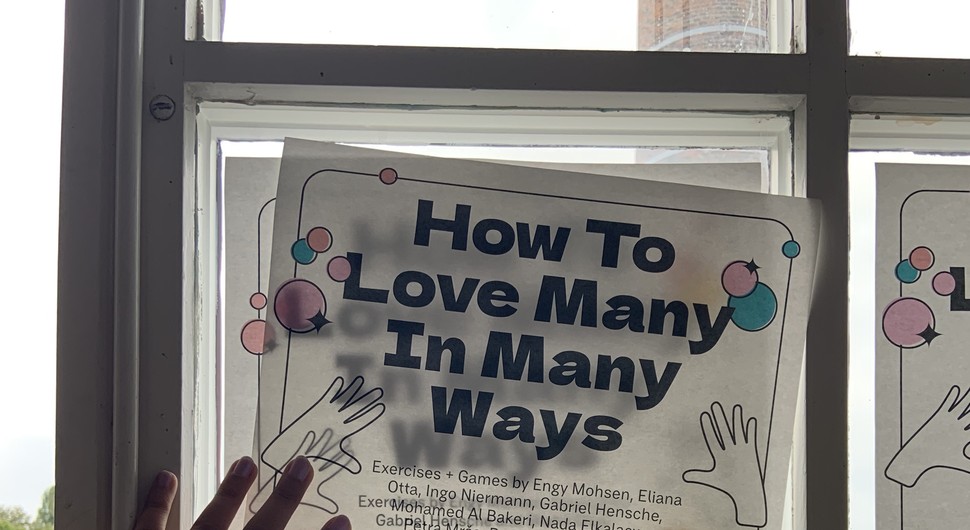
How To Love Many In Many Ways
TIMINGS
Departing from the desire to find different ways in which we can connect with one another, How To Love Many In Many Ways was born while experiencing different moments of on-again-and-off-again home confinement. This affected the structure of the project, as we started to look deeper into the notions of mutual care and ‘love’ in the expanded sense of the word. What, for instance, could love beyond romantic or familial relations mean? What would love beyond friendships look like? And how does love to non-human beings manifest?
To register, click here: https://us06web.zoom.us/j/82443037328
Together with Mohamed Albakeri, Rania Atef, and Shahd Omar, Engy Mohsen will discuss the process of how each contributor arrived at their personal interpretation of the topic and how it eventually manifested into a game/exercise.
Rania Atef has created a game titled “Bad Mother” which critically -and sarcastically- tackles maternal love and domestic labor especially for mothers who also work. Mohamed Al Bakeri has been working on “The Things You Do for Love” which is a game that tackles love as a material need and/or commodity. Engy Mohsen has collaborated with Gabriel Hensche on the titular game “How To Love Many In Many Ways”, which includes a set of rituals that will lead you to question how you care for yourself, connect with others around you, and be more attentive to the things in your surroundings.
Shahd Omar will then join to perform “Embodied Encounters” online together with audiences at home. Shahd has contributed six exercises about consent and how to communicate it with more than just words. In these exercises, she invites participants to step into their bodies to explore what “yes” and “no” feel like. Our bodies speak. Without words, we explore ways of saying yes and no, and also receiving yes and no from others.
The talk and workshop is open for participants of all ages and will be conducted in English and Arabic.
About the speakers:
Engy Mohsen (1995, Cairo), is an artist and architect. She works with spatial design and conversation as a medium to stage discursive acts and explore notions of ‘participation’ and ‘collectivity’.
Mohamed Bakry (1990, Cairo), is a visual artist who is interested in how everyday gestures are performed in male-dominated spaces, in relation to society, politics, sexuality, and religion.
Rania Atef (1988, Cairo), is a multi-disciplinary artist who explores the notions of play across a wide range of mediums to investigate maternal, reproductive, and labor discourses on individual and collective levels.
Shahd Omar (1991, Cairo), is a trauma-sensitive yoga and movement coach. She is interested in finding resilience by meeting the body with a fresh set of eyes and a newfound curiosity