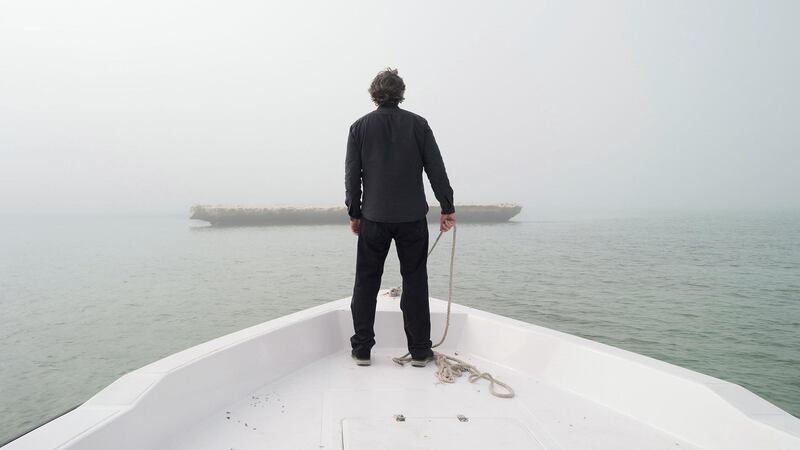
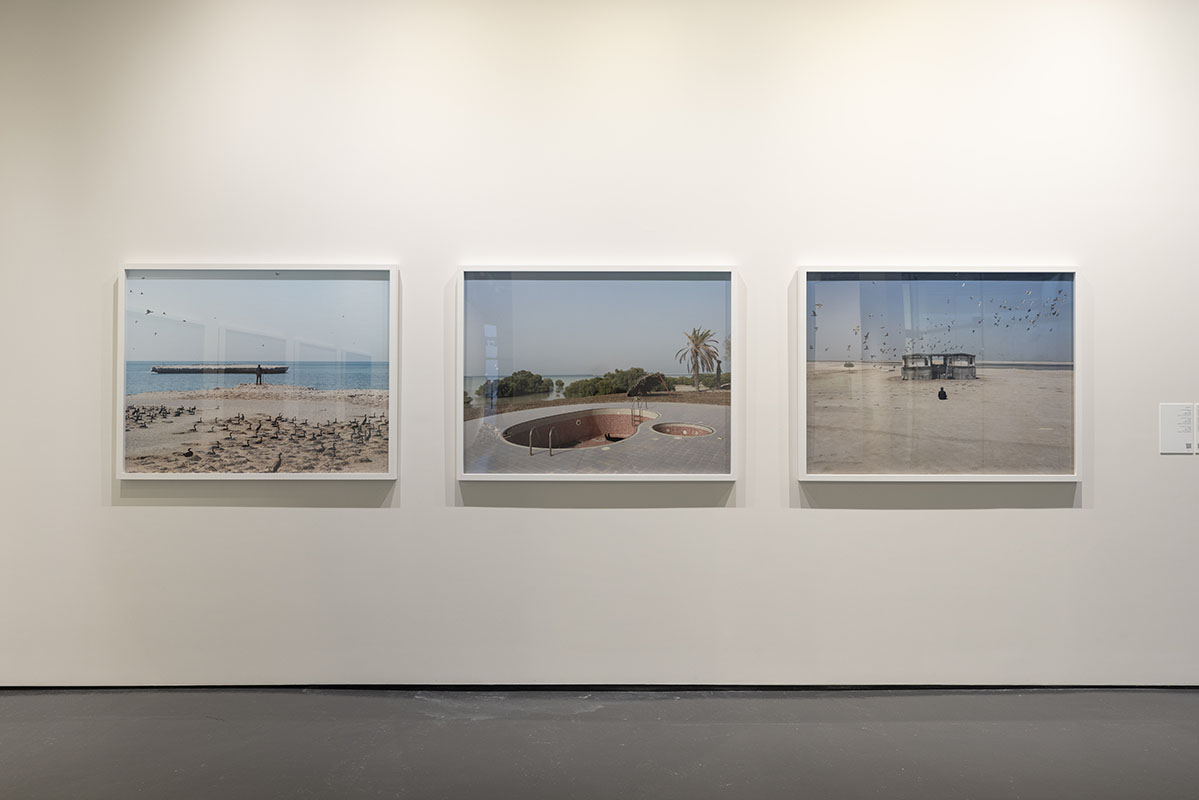
In his Odysseus series (2015–2022), Tarek Al-Ghoussein investigated the psychological and political dimensions of place through the little-known islands off the coast of Abu Dhabi. These territories, largely unfamiliar even to the city’s own inhabitants, exist in a liminal state—geographically within the boundaries of the UAE capital, yet culturally and visually apart from it. In documenting them, Al-Ghoussein created a photographic archive of spaces suspended between visibility and erasure, presence and absence.
Rendered in stark, minimal compositions, the images capture the barren desert terrain intersected by traces of urban infrastructure—roads to nowhere, construction fragments, and architectural remnants. The contrast between natural and built environments lends the work a haunting ambiguity, where time feels slowed and space appears curiously vast. These settings become more than landscapes; they transform into quiet stages for meditations on exile, belonging, and spatial identity.
Rooted in Al-Ghoussein’s broader practice, which spanned photography, performance, and land art, Odysseus continued his exploration of the individual’s relationship to place—especially within contexts of displacement and geopolitical transition. Named after the mythic voyager, the series reflects a search for home that is neither nostalgic nor conclusive. Instead, it offers a sustained inquiry into how identity is formed in relation to the territories we move through—whether claimed, forgotten, or in-between.